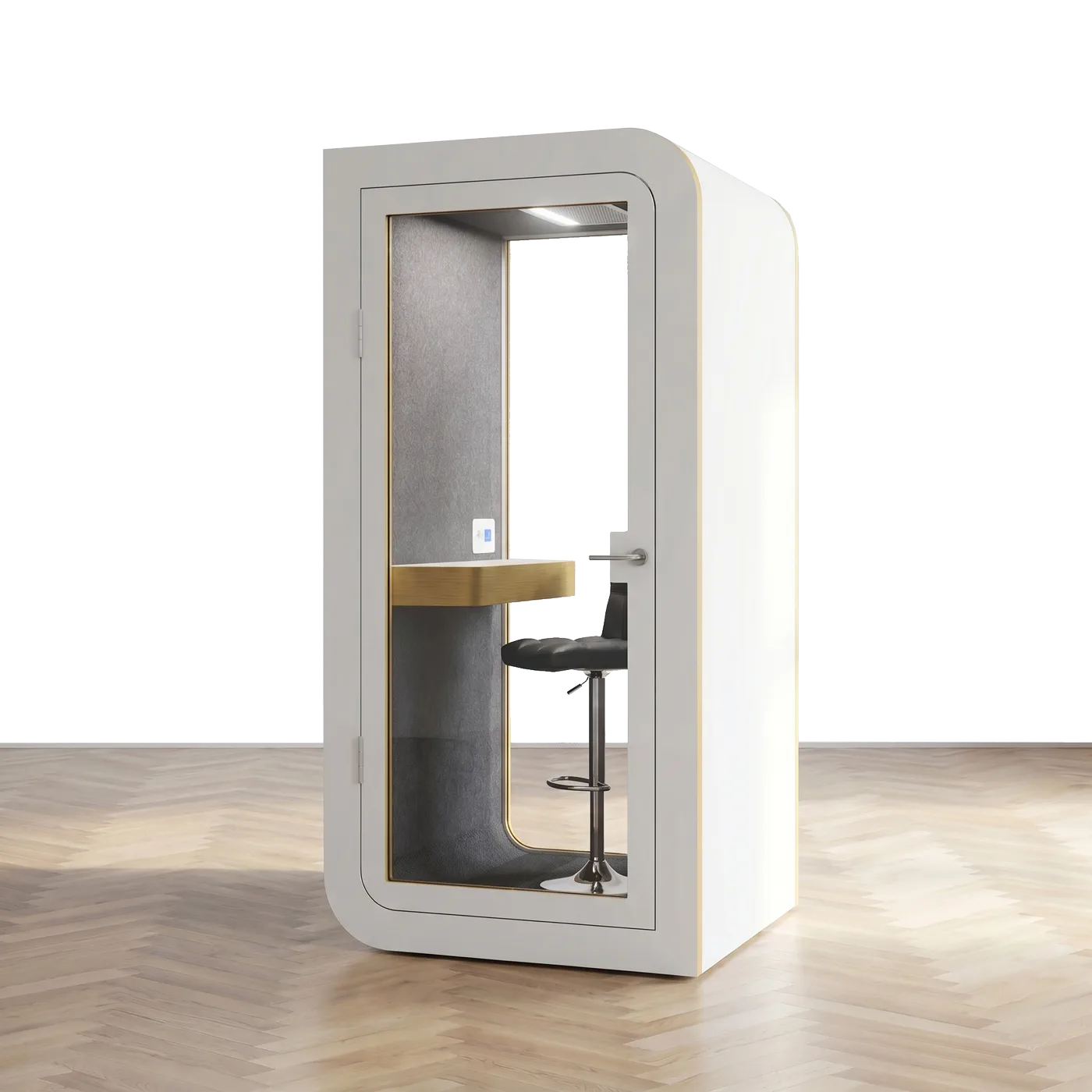
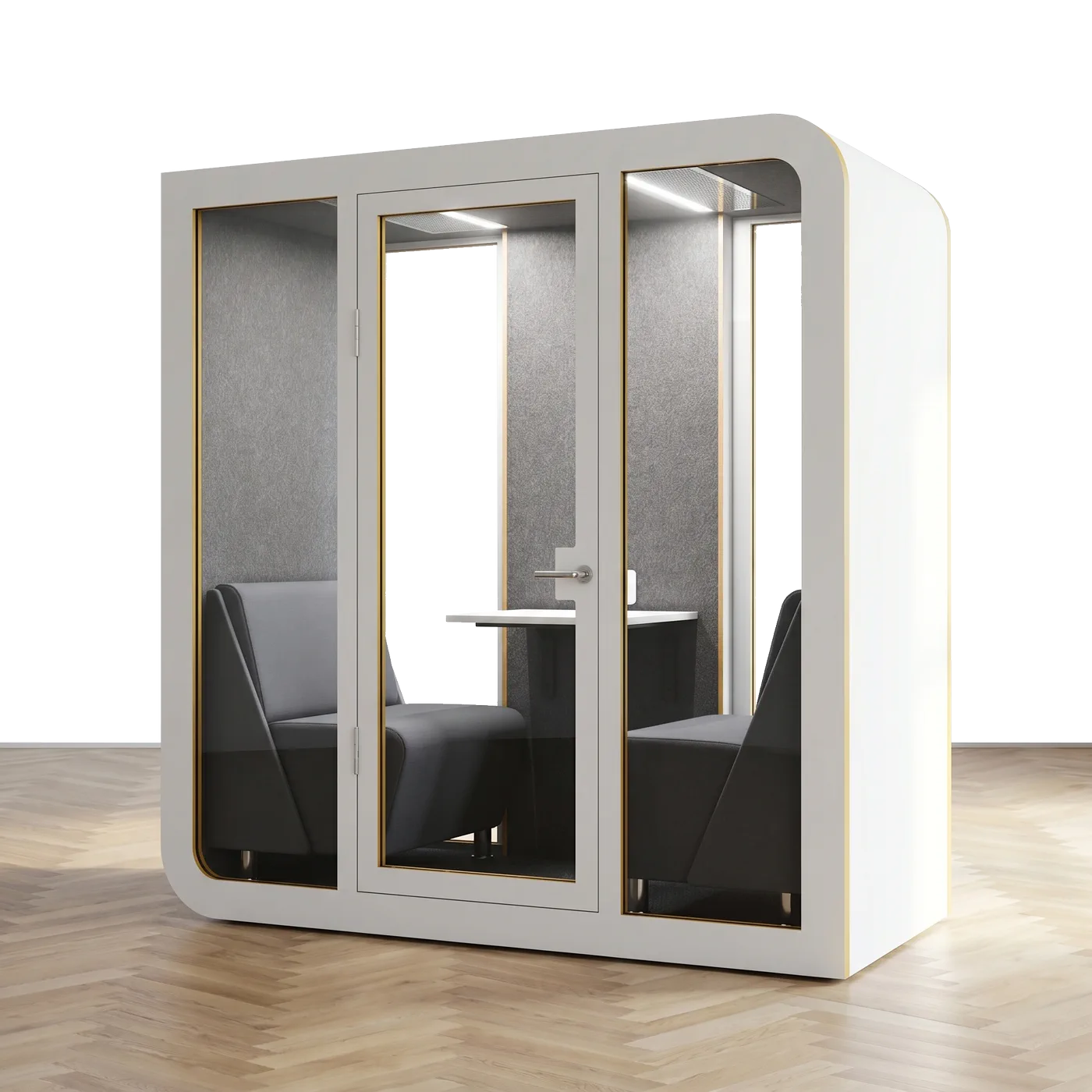
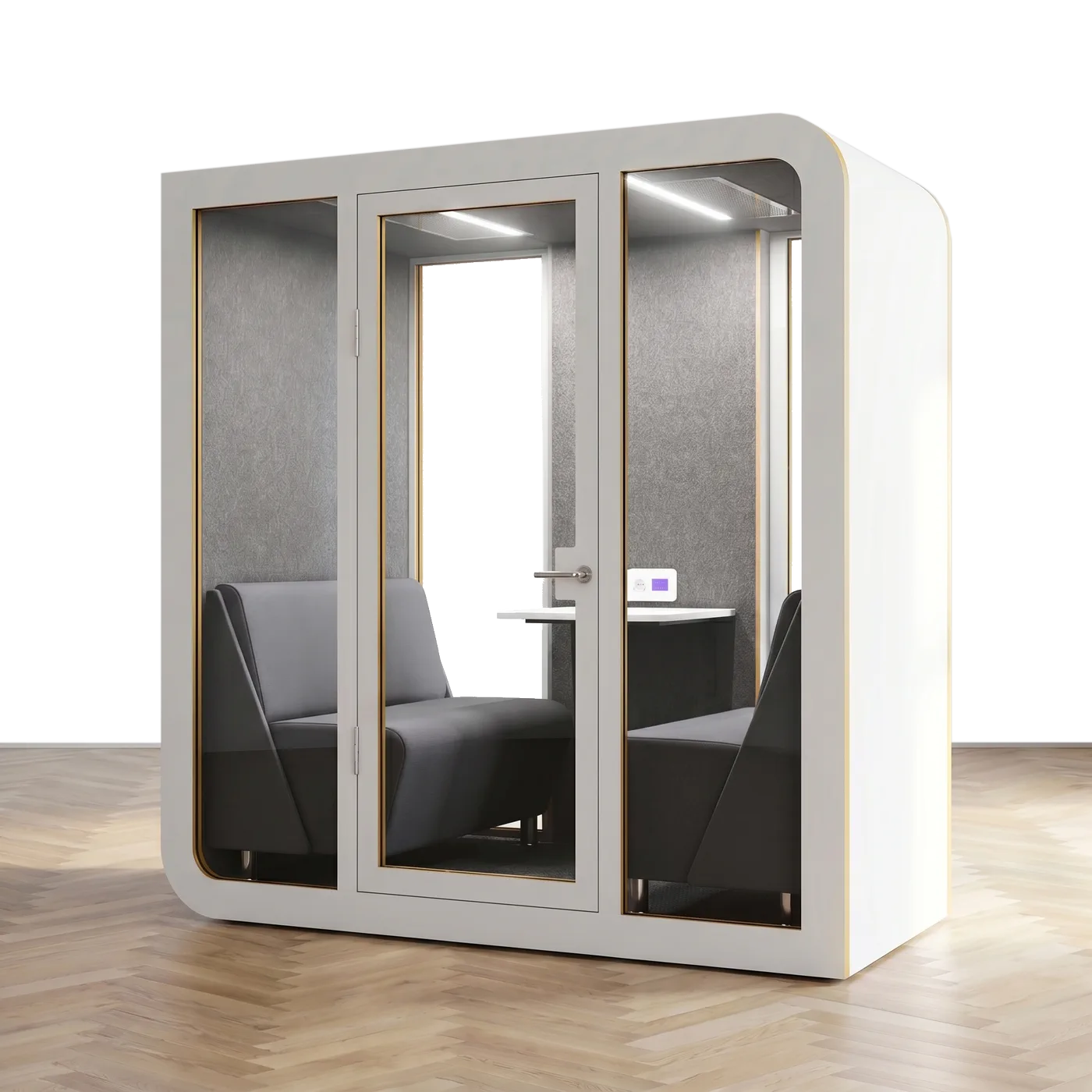
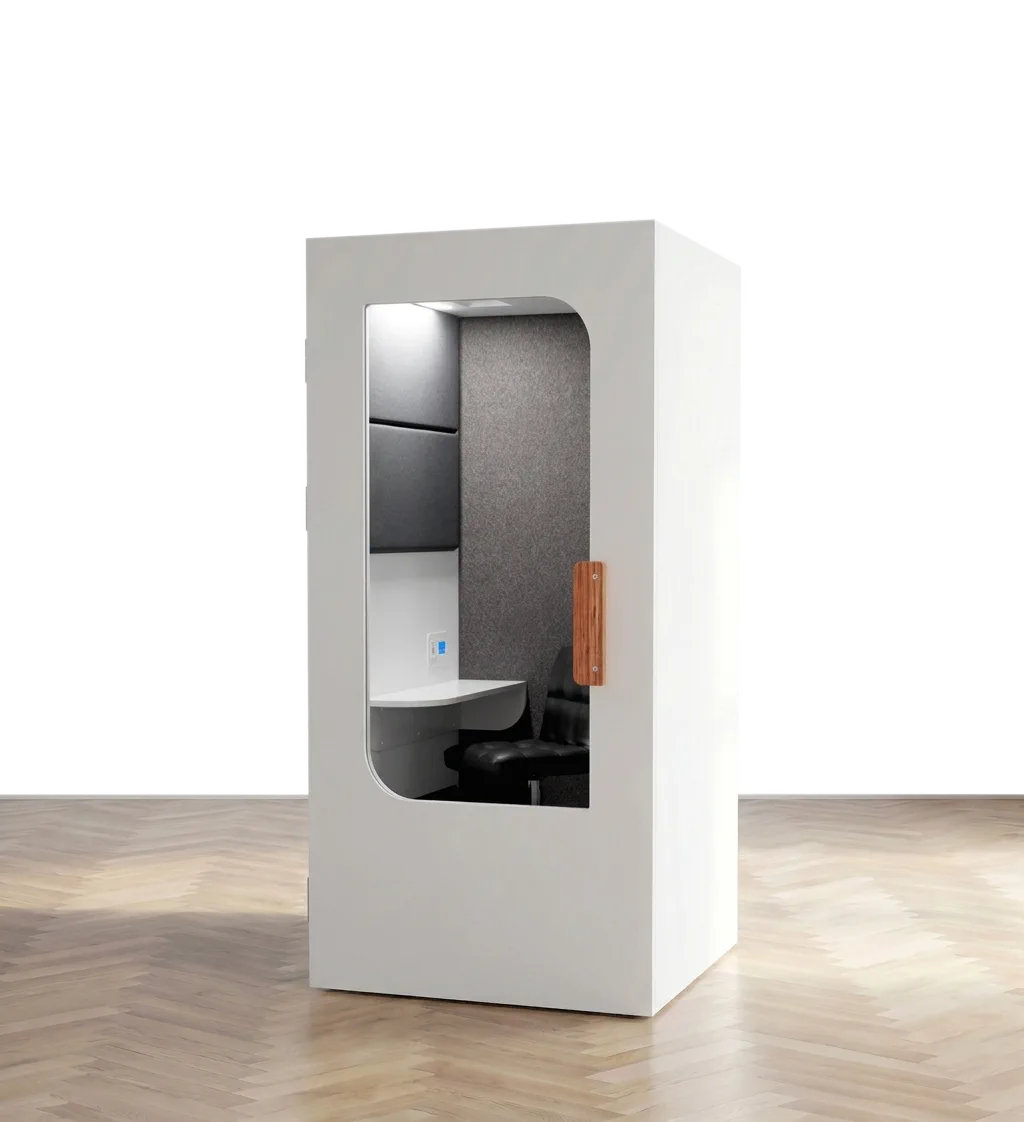
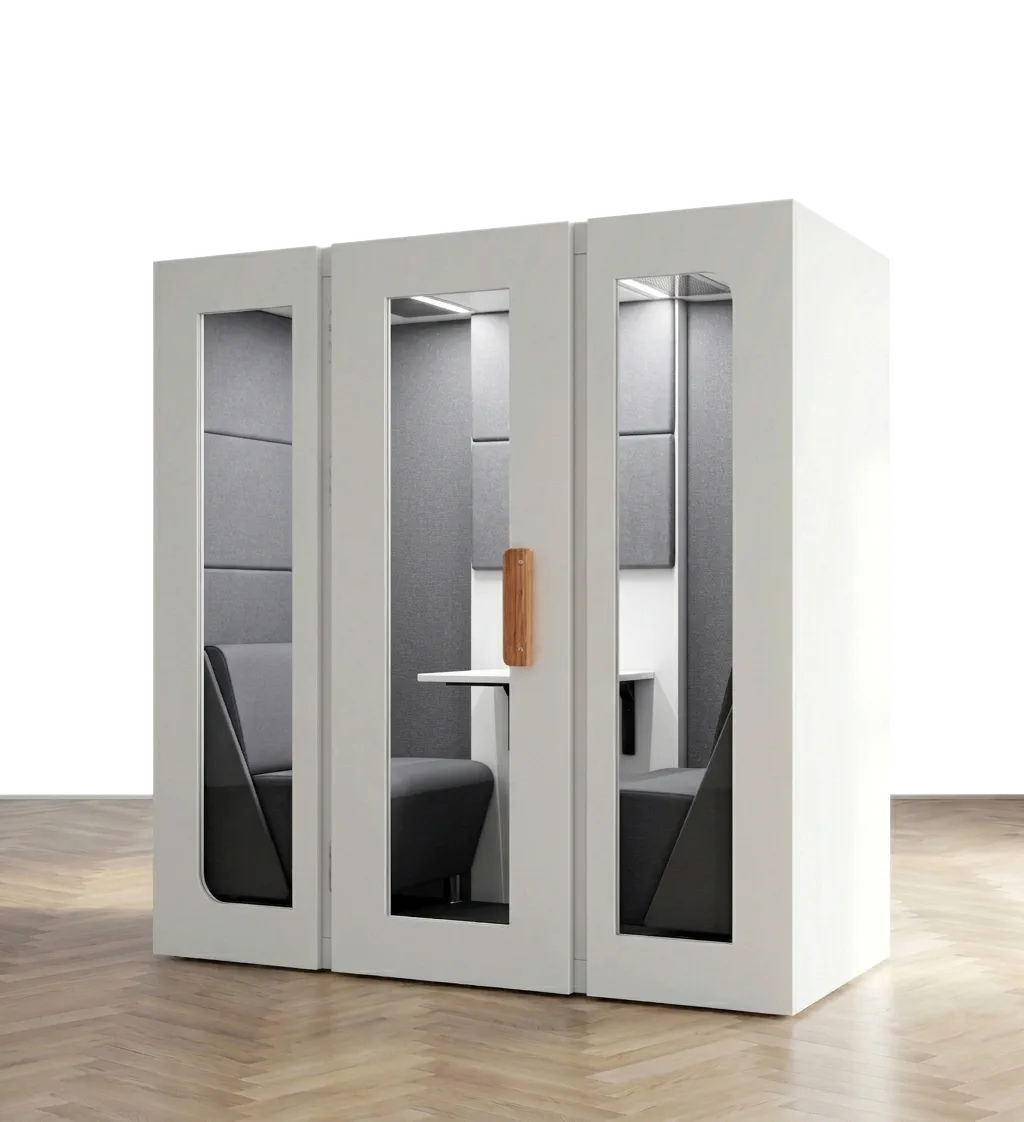
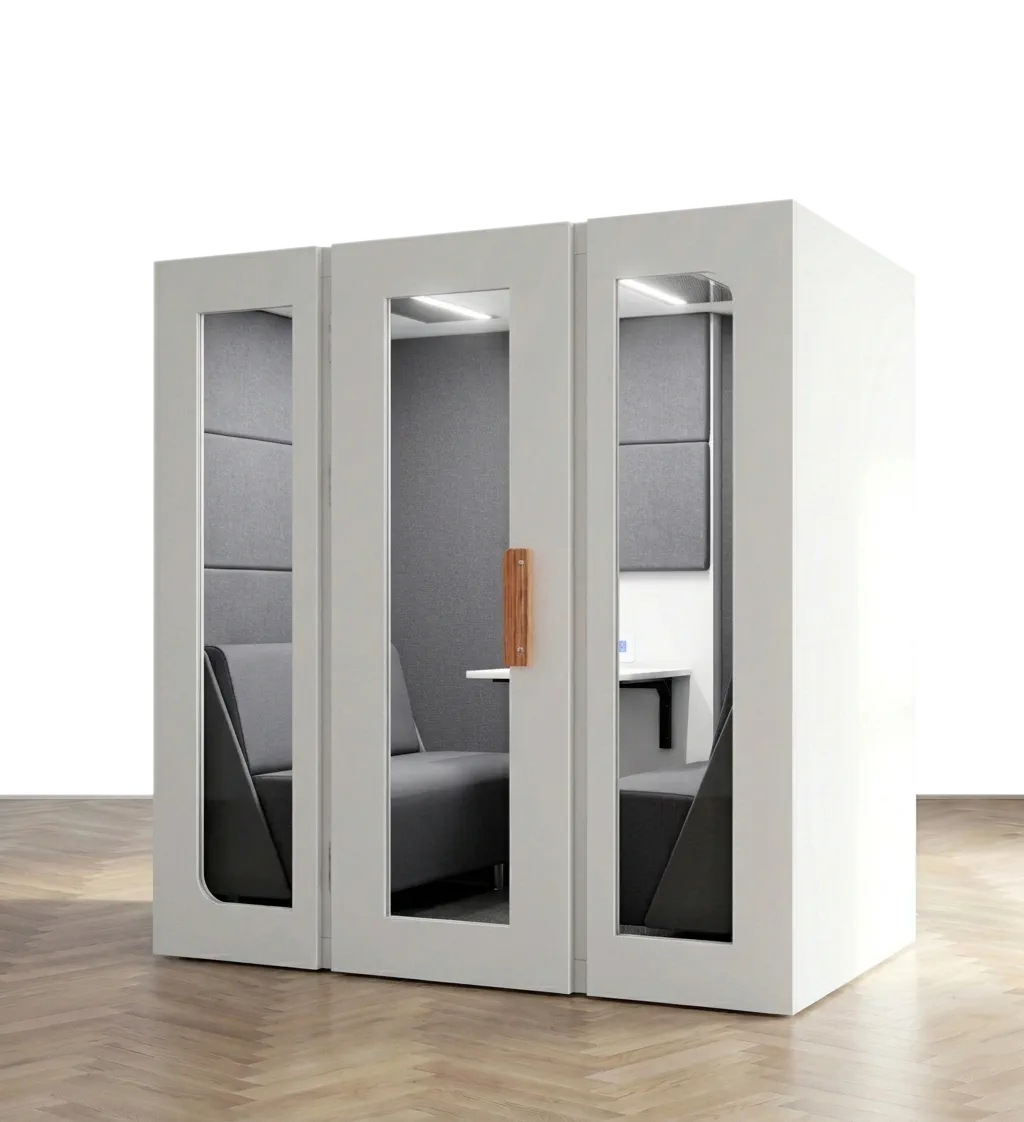
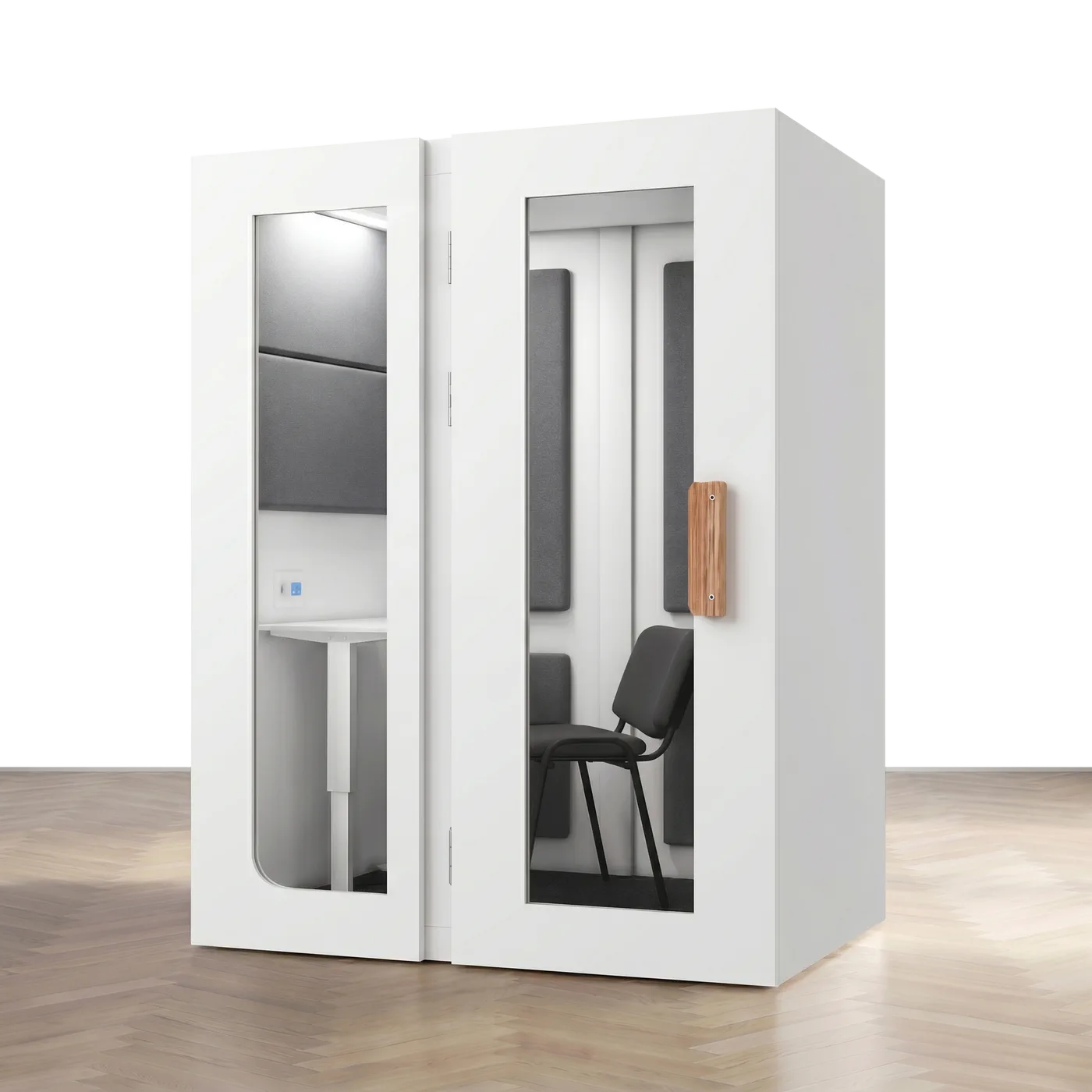
When choosing an acoustic office booth, it is worth understanding what the quoted sound insulation figure actually proves. The number in the specification matters, but it matters just as much which standard the tests followed and what results the specific model achieved.
Several different standards and documents apply to acoustic booths, and not every one of them is a soundproofing certificate. This article looks at ISO 11957 and ISO 23351-1:2020, which describe the acoustic performance of booths, and explains how they differ from other documents — ISO 9001, CE and RoHS.
Which tests and certificates confirm a booth's sound insulation
The sound insulation of a booth is determined in laboratory testing that follows a defined method. The standards used for this describe both the measurement conditions and the way results are evaluated.
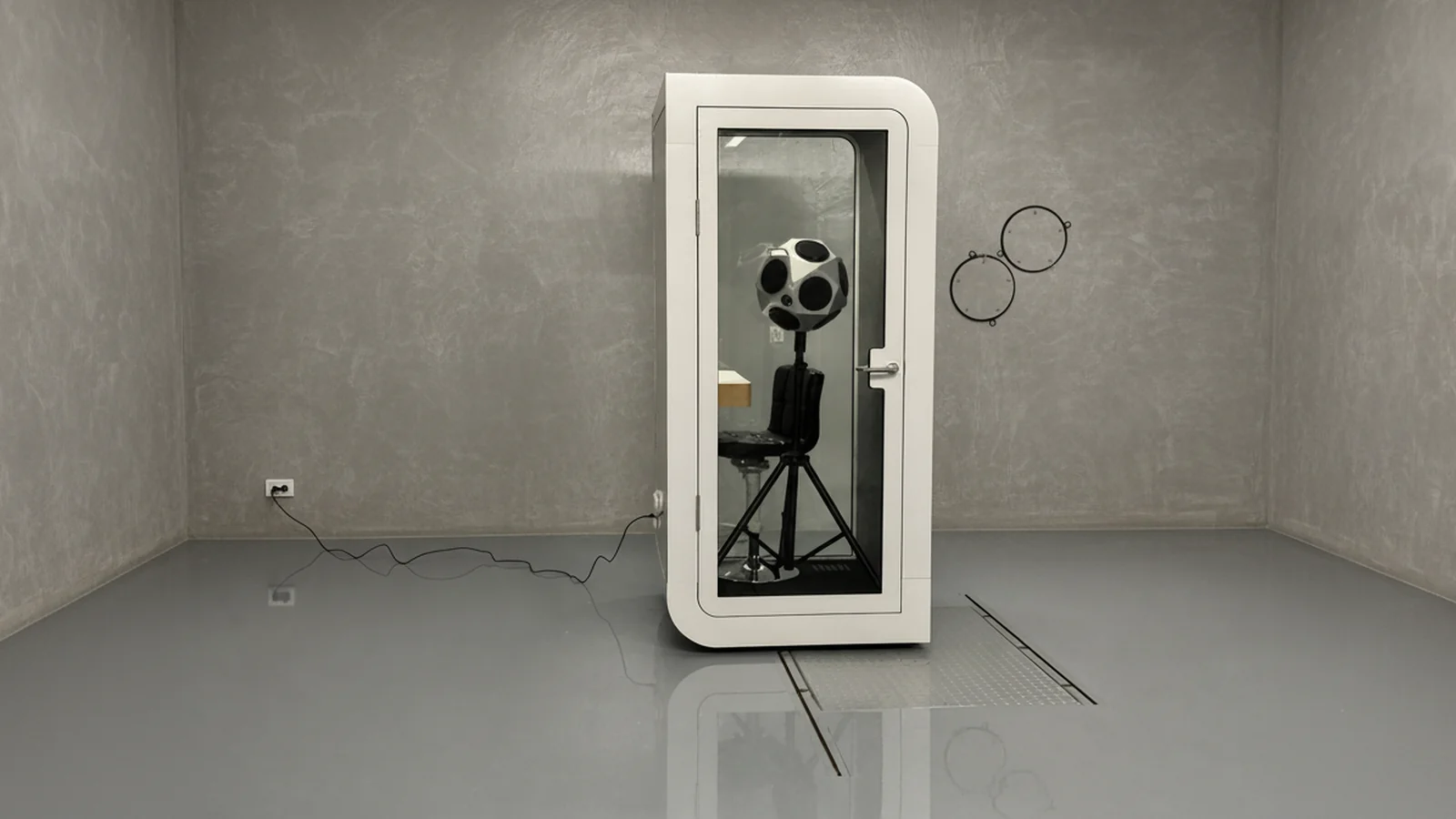
Silentbox holds laboratory test reports to ISO 11957 and ISO 23351-1:2020, carried out at the Laboratory of Technical Acoustics at AGH in Kraków.
The two standards assess a booth's acoustic performance in different ways. ISO 11957 determines the sound insulation of the structure, while ISO 23351-1:2020 measures speech level reduction and assigns a class based on the test result.
ISO 11957 — the standard for sound insulation of booths
ISO 11957 “Acoustics — Determination of sound insulation performance of cabins” sets out the method for determining the sound insulation of booths.
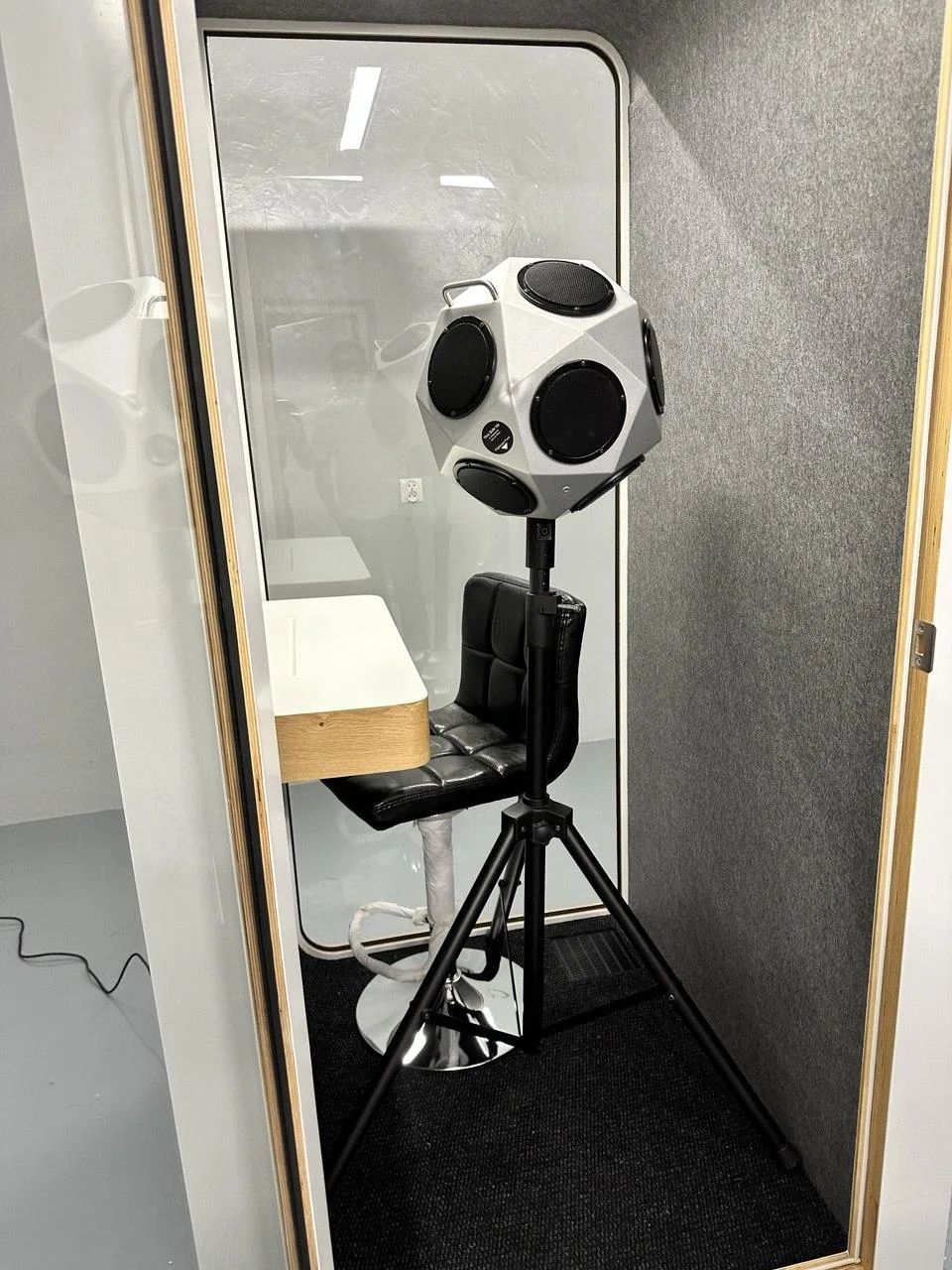
The test establishes how far the structure reduces sound transmission between the inside of the booth and the space around it. Measurements cover a wide frequency range, and the result is reduced to the single-number quantity Dp,w in accordance with ISO 717-1.
For the buyer, the key point is that such a report evaluates the acoustic performance of the specific structure that was tested — not merely the materials it is built from.
Silentbox booths were tested to ISO 11957 at the Laboratory of Technical Acoustics, Department of Mechanics and Vibroacoustics, AGH in Kraków.
ISO 23351-1:2020 — speech level reduction and classes A–D
ISO 23351-1:2020 “Measurement of speech level reduction of furniture ensembles and enclosures” takes a different approach to assessing acoustic performance.
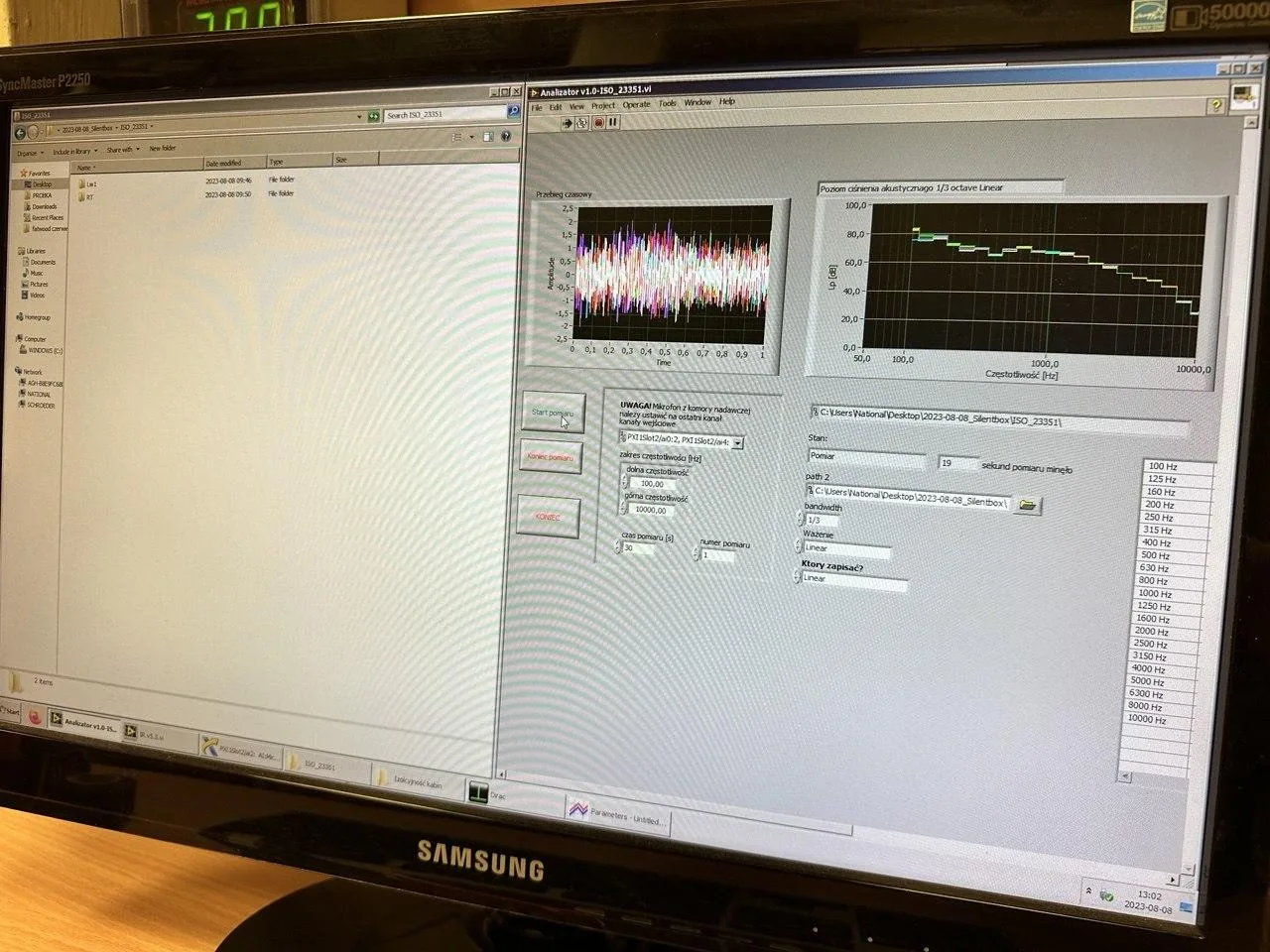
The standard determines speech level reduction (DS,A) and classifies the result into classes A to D. It is this classification that makes the standard convenient for comparing acoustic booths with one another.
- Class A — the conversation cannot be made out even immediately next to the booth
- Class B — speech is unintelligible to people working nearby
- Class C — the content of the conversation is not picked up at normal working distance
- Class D — audibility is noticeably reduced, but privacy remains limited
The class follows from test results obtained in accordance with the standard. That is why it is worth looking beyond the letter A, B, C or D to the report itself, which states the method, the laboratory and the specific model.
Silentbox is the only Ukrainian manufacturer of acoustic booths to have completed testing to ISO 23351-1:2020 at the AGH laboratory in Kraków.
The class and the DS,A value are stated in the test report for the relevant model.
ISO 11957 and ISO 23351-1: what is the difference?
Both standards are used to assess the acoustic performance of booths, but their approaches differ.
- ISO 11957 — sound insulation of the booth across a wide frequency range; an overall acoustic figure for the structure.
- ISO 23351-1:2020 — speech level reduction, that is, conversation privacy, with the result classified from A to D.
The two standards complement each other, and their figures should not be treated as interchangeable.
Two different “class A” ratings: sound insulation and sound absorption
The letter A appears in several acoustic standards, but it denotes a different property in each of them.
A class under ISO 23351-1 relates to speech level reduction and acoustic privacy — how audible a conversation is outside the booth. A sound absorption class under EN ISO 11654 describes the ability of a material or structure to absorb sound within a space.
These are two different properties. Sound absorption helps control echo and acoustic comfort inside the booth. Sound insulation concerns the transmission of sound between the booth and the surrounding space.
A “Class A” label should therefore always be read together with the name of the standard behind it.
ISO 9001:2015 — quality management system
Alongside its acoustic test reports, Silentbox also holds an ISO 9001:2015 certificate, which covers the manufacturer's quality management system.
That standard governs quality management processes and says nothing about the sound insulation of any particular booth. The acoustic performance of Silentbox is confirmed by separate laboratory testing to ISO 11957 and ISO 23351-1:2020.
How CE and RoHS differ from acoustic test reports
The CE mark is a manufacturer's declaration that the product meets the requirements of EU directives: safety of the structure, of the electrical equipment and of the materials. It is mandatory for access to the European market, but it neither measures nor confirms sound insulation — the CE directives contain no acoustic requirements.
RoHS concerns the composition of electrical and electronic components: restrictions on lead, mercury, cadmium and other hazardous substances. For an acoustic booth this means safe ventilation, lighting and sockets — but it says nothing about the level of quiet achieved.
CE and RoHS should therefore be read as confirmation that the product is safe and lawful on the EU market, while acoustic performance is verified separately — through test reports to ISO 11957 and ISO 23351-1:2020.
Conclusions
The sound insulation of an office booth is a property confirmed by an acoustic test report, not by a marketing figure. For Silentbox, this testing was carried out to ISO 11957 and ISO 23351-1:2020 at the AGH laboratory in Kraków.
Test results show the acoustic performance of specific models, and the A–D classes under ISO 23351-1 give an additional way to judge speech level reduction.
Other documents — ISO 9001, CE and RoHS — relate to different aspects of the product: the quality management system, conformity with EU requirements and the composition of the electrical equipment.
Silentbox laboratory test reports and certificates are available on the “Certificates and documentation” page, and you can compare levels of sound insulation by ear in the interactive Sound Lab on the site.