
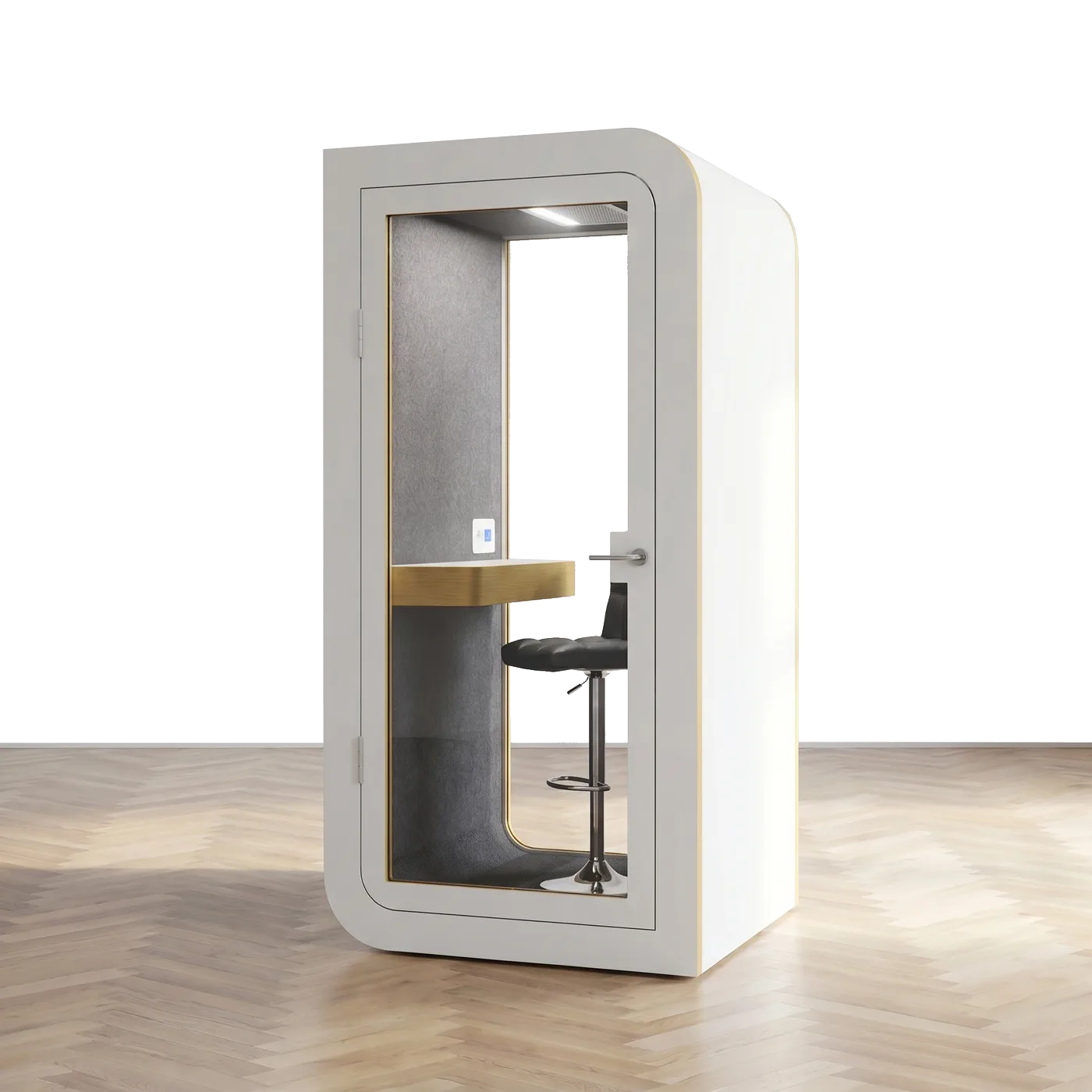
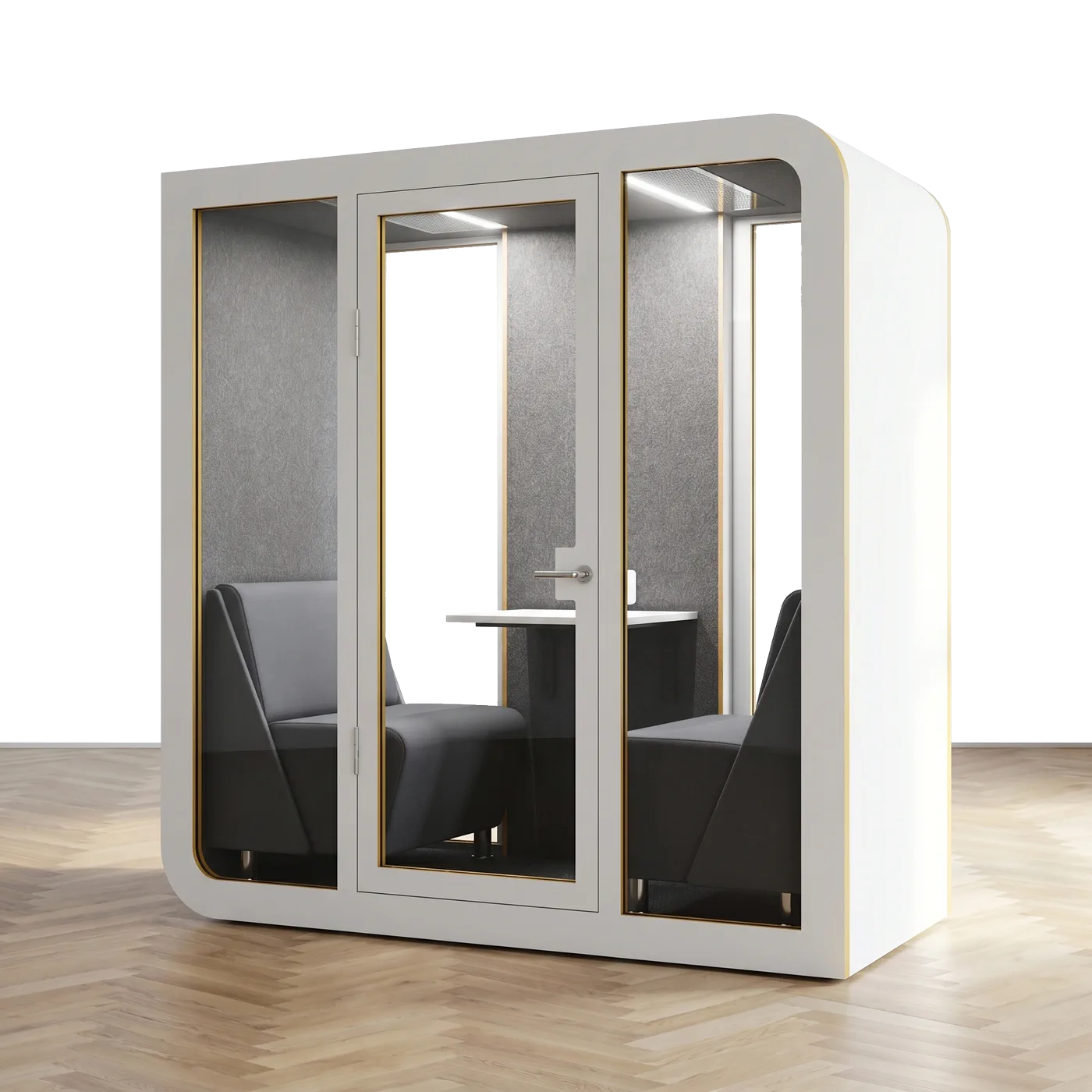
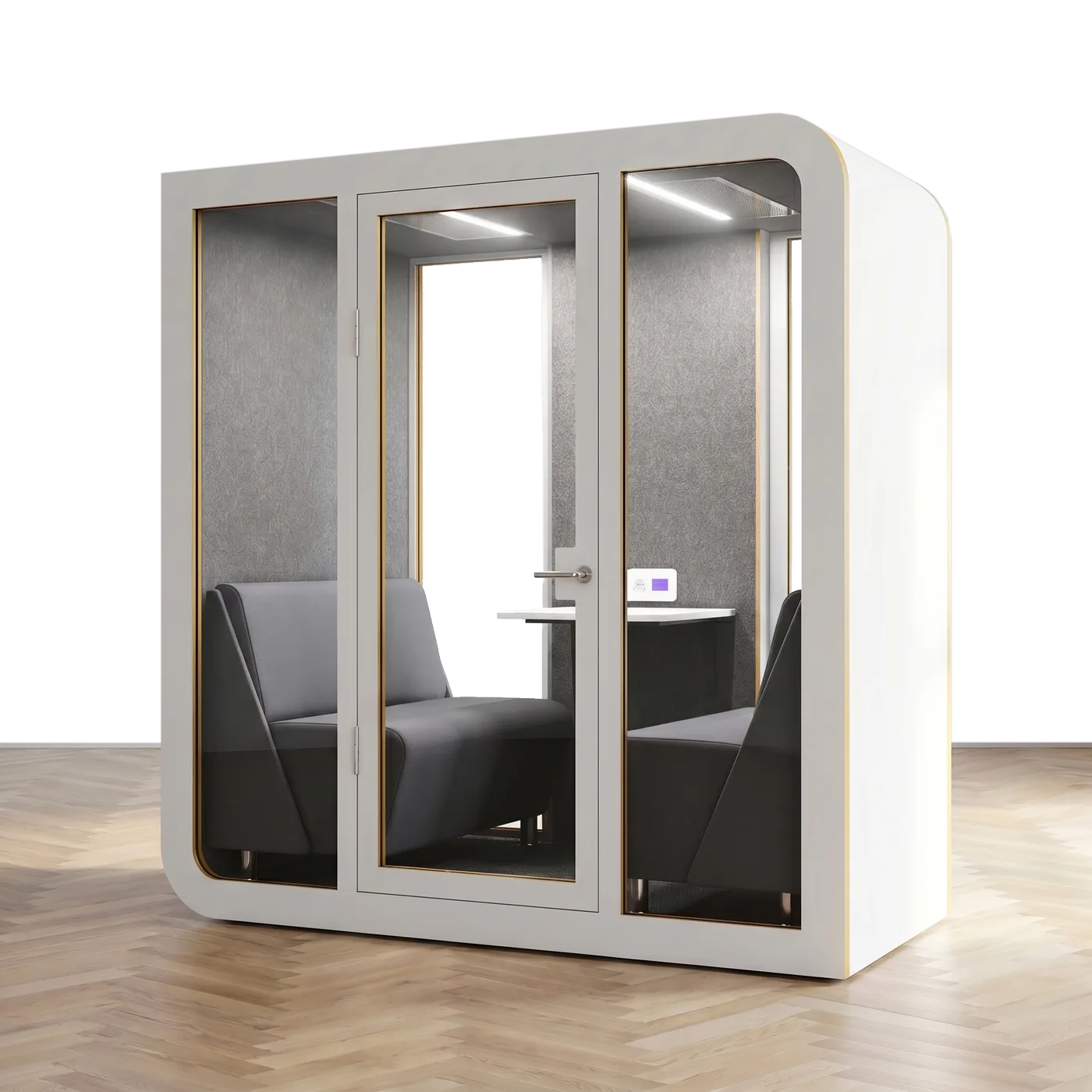
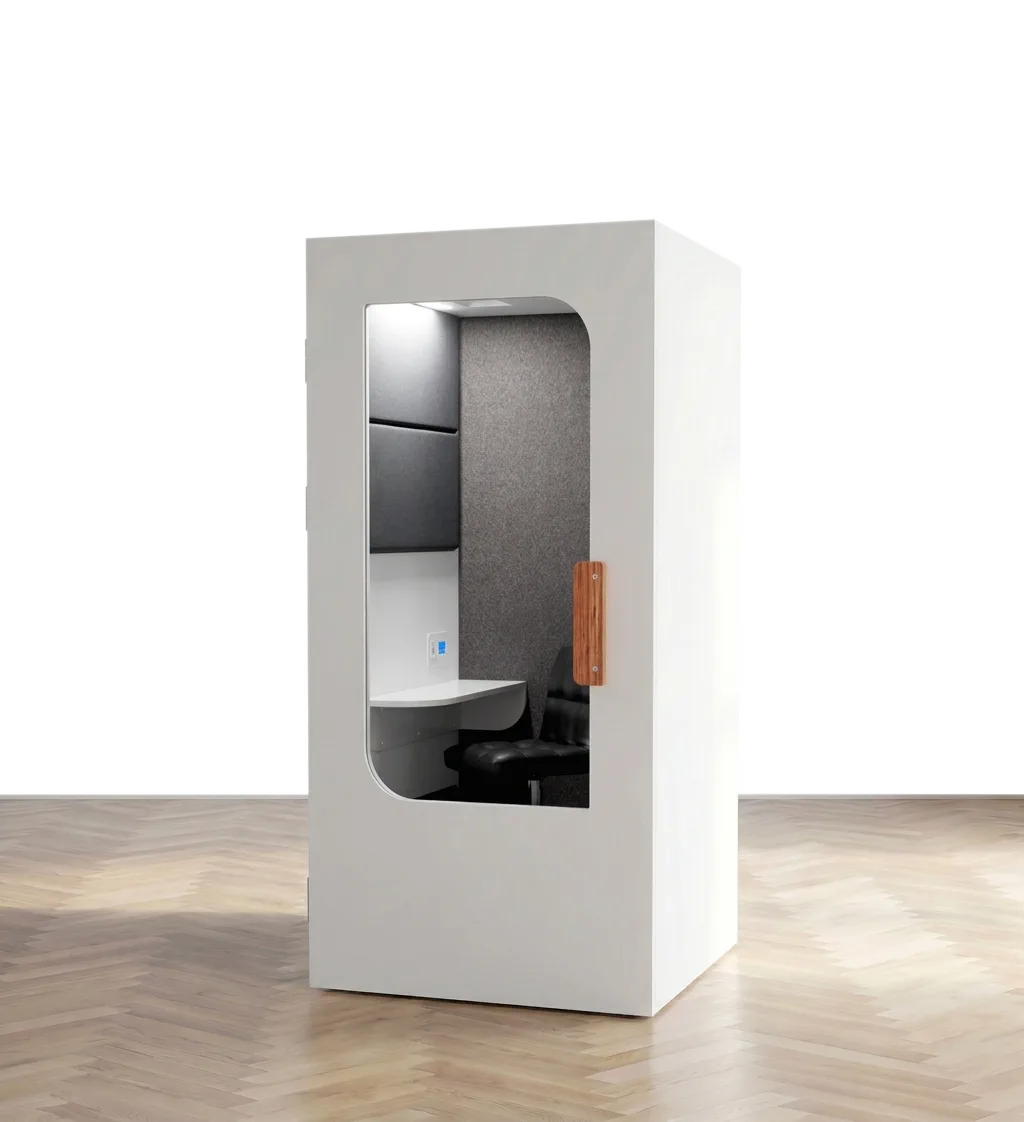
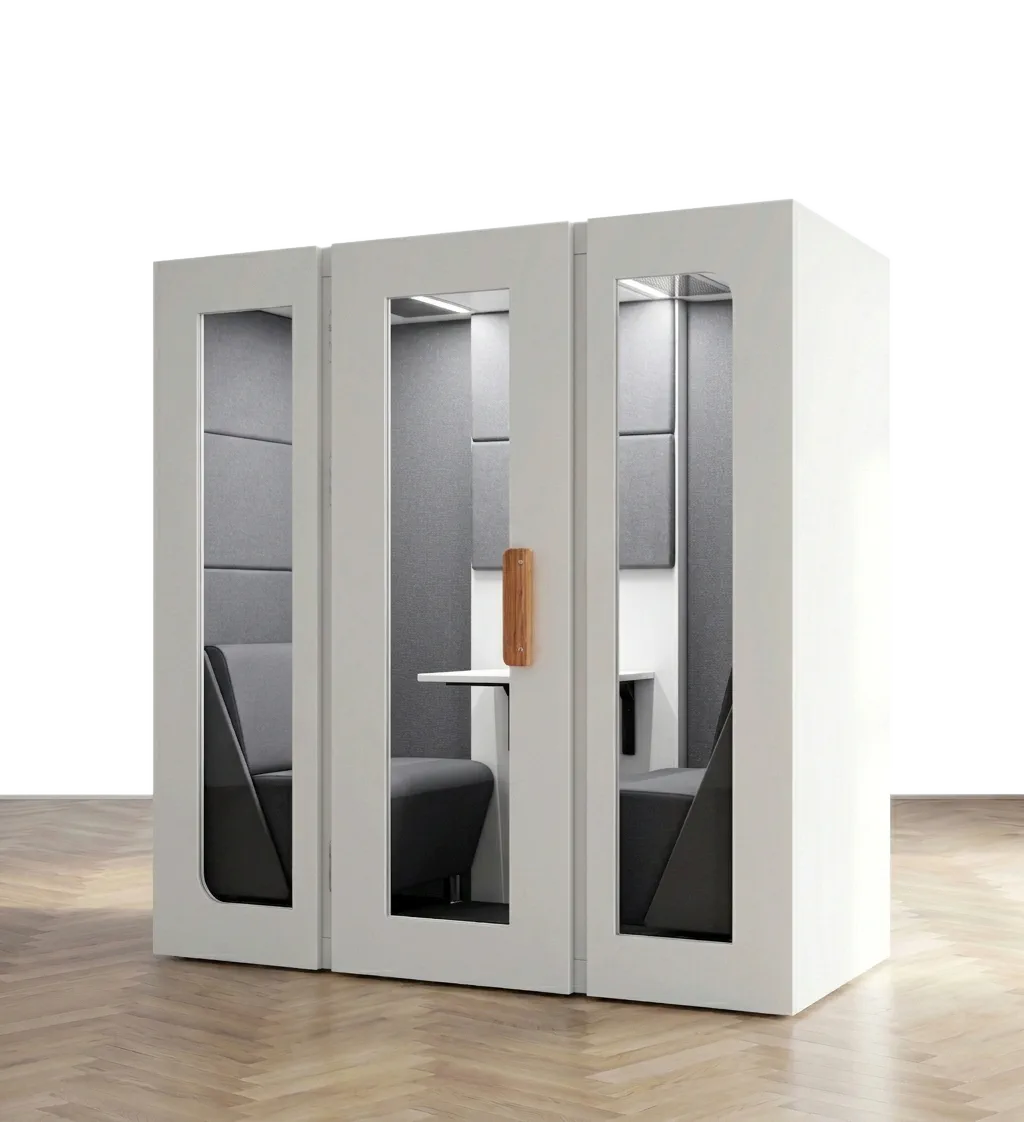
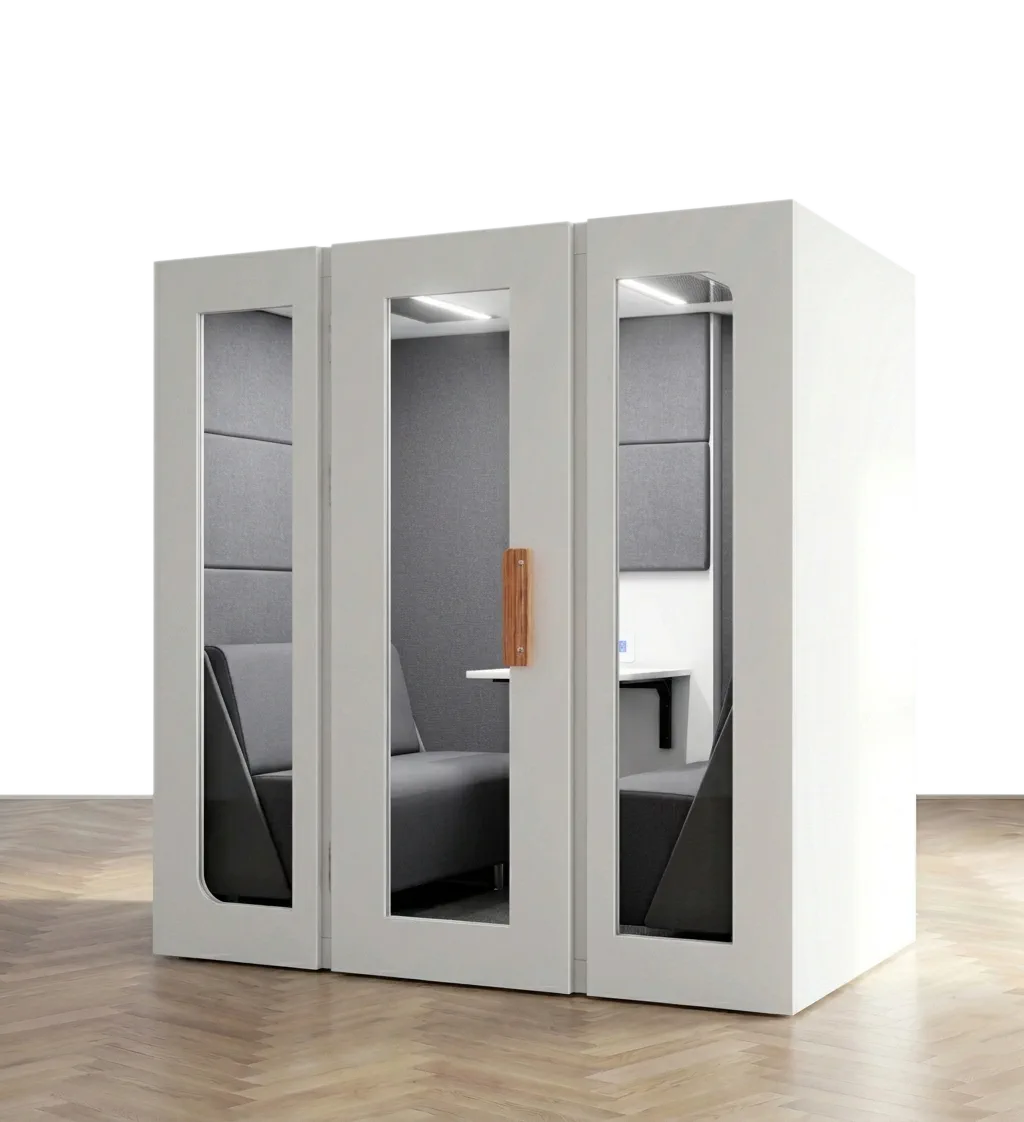
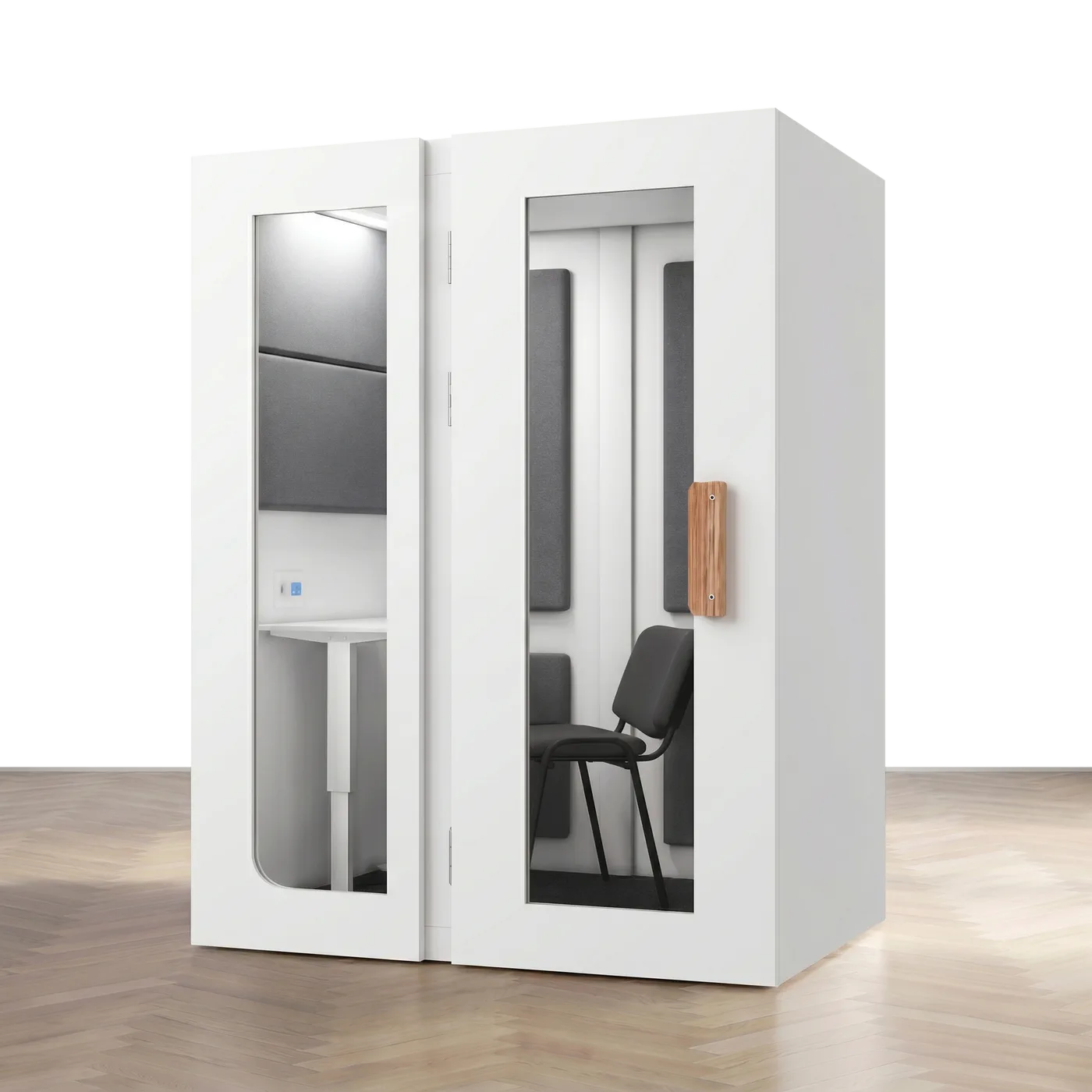
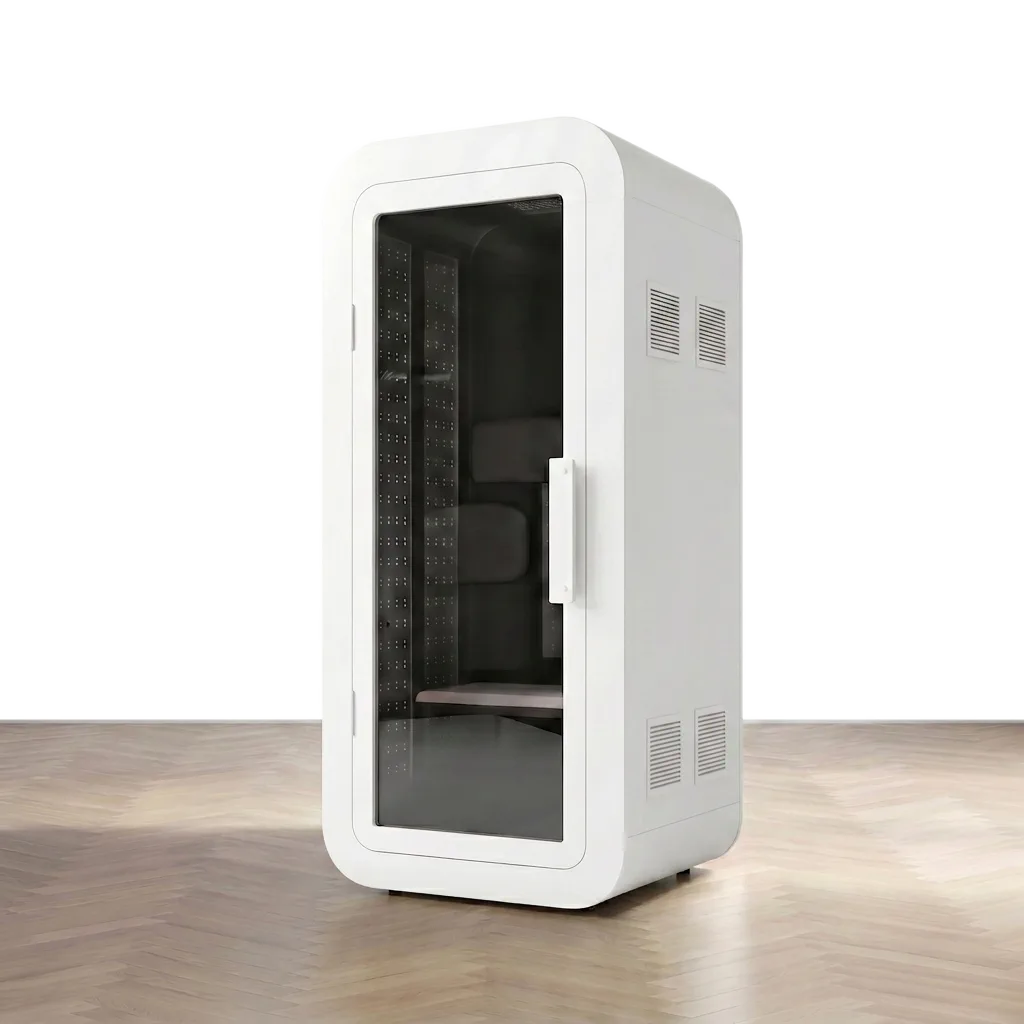
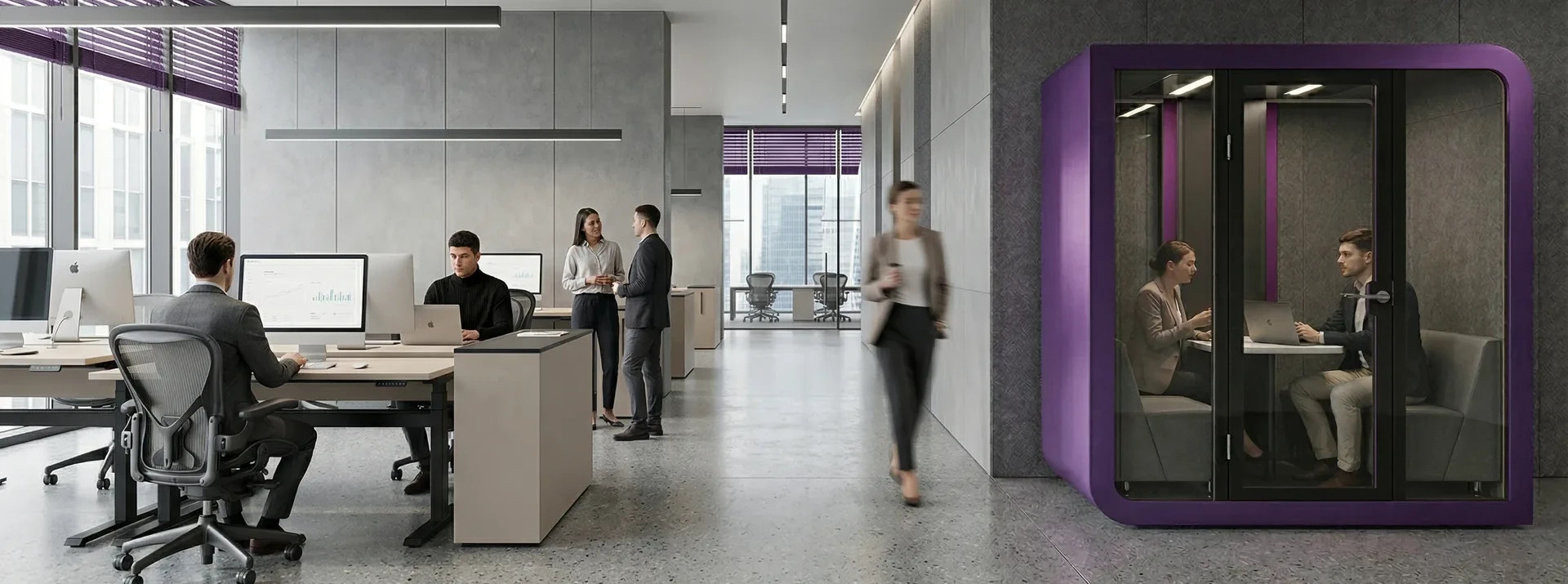
Ventilation is critical because a booth that keeps sound in also keeps air in: without its own air supply and exhaust, stale air would build up in a closed booth. Every Silentbox booth has its own forced ventilation rated at 250–600 m³/h depending on the model, with supply and exhaust in the ceiling, an occupancy sensor and acoustic silencers.
This guide explains how ventilation in an acoustic booth works: airflow by size, the air path, controls and noise, the rules in Great Britain on fresh air at work, and what to check before you buy.
Why a tight booth needs active ventilation
People breathe out warmth and moisture. In an open office, that warmth and moisture disperse through a large volume of air; in a booth for one to four people the volume is small, and the closed shell stops air leaking in through gaps. The walls, glass and door that hold back sound also hold back air, so the better a booth insulates, the more it depends on active ventilation. A stuffy booth is one that people stop using, however quiet it is.
Airflow by booth size
Airflow in cubic metres per hour (m³/h) shows how much air the ventilation moves. Silentbox states it per model, and it should be read together with the number of people the booth is built for. Ask for the value of the exact model you plan to install, not a figure for a whole series.
Ventilation airflow by booth size
| Booth size | Models | Airflow |
|---|---|---|
| One person | Solo Premium | 300 m³/h |
| One person | Solo Lite | 250–300 m³/h |
| One person | WorkPod | 250–300 m³/h · 2 fans |
| Two to four people | Duet Premium, Quartet Premium, Duet Lite, Quartet Lite | 550–600 m³/h |
Airflow as stated on the Silentbox model cards.
How the air moves: ceiling supply and exhaust
In every Silentbox booth, both supply and exhaust sit in the ceiling unit; for the Duet Premium, the catalogue describes two ceiling units with ventilation grilles and LED fixtures. The booth needs no connection to the building's ventilation: it is free-standing and plugs into a standard 220 V socket. One consequence is easy to overlook. The booth takes its air from the office and returns it there, so the air inside can be no fresher than the office around it.
Switching on, control and noise
An occupancy sensor switches the ventilation on automatically when someone steps in; the LED lighting has its own motion sensor. On the Solo Premium a touchscreen controls ventilation and lighting, and on the Solo Lite it sets fan speed and light brightness. Every air opening is a potential path for sound, which is why the air runs through acoustic silencers. The catalogue describes the ventilation as quiet and gives no decibel figure for the fan, so listen to it at an installed booth. Ventilation is covered for 3 years on every model: the Premium warranty gives 3 years on moving parts and ventilation, and Solo Lite, Duet Lite, Quartet Lite and WorkPod carry a 3-year warranty.
What the rules in Great Britain say about fresh air, and who is responsible
In Great Britain, regulation 6(1) of the Workplace (Health, Safety and Welfare) Regulations 1992 requires every enclosed workplace to be ventilated with enough fresh or purified air. HSE's guidance on these regulations (L24, para 57) adds that the fresh-air rate “should not normally fall below 5 to 8 litres per second, per occupant”. In England, Approved Document F sets a design figure for offices:
Outdoor air should be supplied for occupiable rooms in offices at whichever of the following will provide the higher total rate. a. 10 litres per second per person. b. 1 litre per second per m² floor area.
Approved Document F, Volume 2 (2021 edition, England), para 1.32
Converted at 1 l/s = 3.6 m³/h (our arithmetic), the 10 l/s per person of Approved Document F is 36 m³/h, and the HSE range of 5 to 8 l/s is 18–28.8 m³/h. These are duties of the employer and the building designer. A booth's airflow is a different quantity: its fans move office air through the booth and do not replace the building's ventilation.
Fresh-air figures in British rules — for buildings, not booths
| Document | Applies to | Figure | Per person in m³/h |
|---|---|---|---|
| Approved Document F, Vol. 2, para 1.32 (England) | Occupiable rooms in offices | 10 l/s per person, or 1 l/s per m² if higher | 36 |
| HSE L24, para 57 (Great Britain) | Enclosed workplaces (reg. 6, Workplace Regulations 1992) | Not normally less than 5–8 l/s per occupant | 18–28.8 |
Conversion is our arithmetic (1 l/s = 3.6 m³/h). The figures apply to buildings and workplaces, not to booths.
Where to put a booth, and what to check before buying
A booth needs a flat, solid floor and a 220 V socket nearby, and it should not stand under ceiling air-conditioning diffusers, which interfere with its own ventilation. Before you buy, check:
- Airflow in m³/h for the exact model.
- How many people the model is built for.
- Where supply and exhaust sit.
- Controls: an occupancy sensor and adjustable fan speed.
- Fan noise, heard at an installed booth.
- The office's own ventilation, because the booth uses that air.
Questions about booth ventilation
Does it get stuffy inside?
No. Every booth has its own forced ventilation rated at 250–600 m³/h with an occupancy sensor: both supply and exhaust sit in the ceiling unit. The fan runs quietly thanks to acoustic silencers, so it does not get in the way even on long calls.
How much fresh air does a person need in an office?
In England, Approved Document F asks for 10 litres per second per person in offices, or 1 l/s per m² of floor if that gives more; HSE's L24 guidance puts the rate at not normally less than 5 to 8 l/s per occupant. Both apply to buildings and workplaces, not to a booth's fans.
How loud is the fan during a call?
The catalogue describes the ventilation as quiet, with acoustic silencers, and gives no decibel figure for the fan. Listen at an installed booth during a call.
Does the booth need to be connected to the building's ventilation?
No. Every booth has its own forced ventilation, is free-standing and plugs into a standard 220 V socket.
Where should a booth not be placed?
Not under ceiling air-conditioning diffusers, hard against the only evacuation exit, or on soft, uneven flooring. The door must open freely.
Sources
- Approved Document F: Ventilation, Volume 2 — Buildings other than dwellings (2021 edition, for use in England), PDF
- The Workplace (Health, Safety and Welfare) Regulations 1992, regulation 6 (legislation.gov.uk)
- HSE L24: Workplace health, safety and welfare — Approved Code of Practice and guidance (second edition, 2013), PDF
- GOV.UK: Ventilation: Approved Document F (publication page, applies to England)