
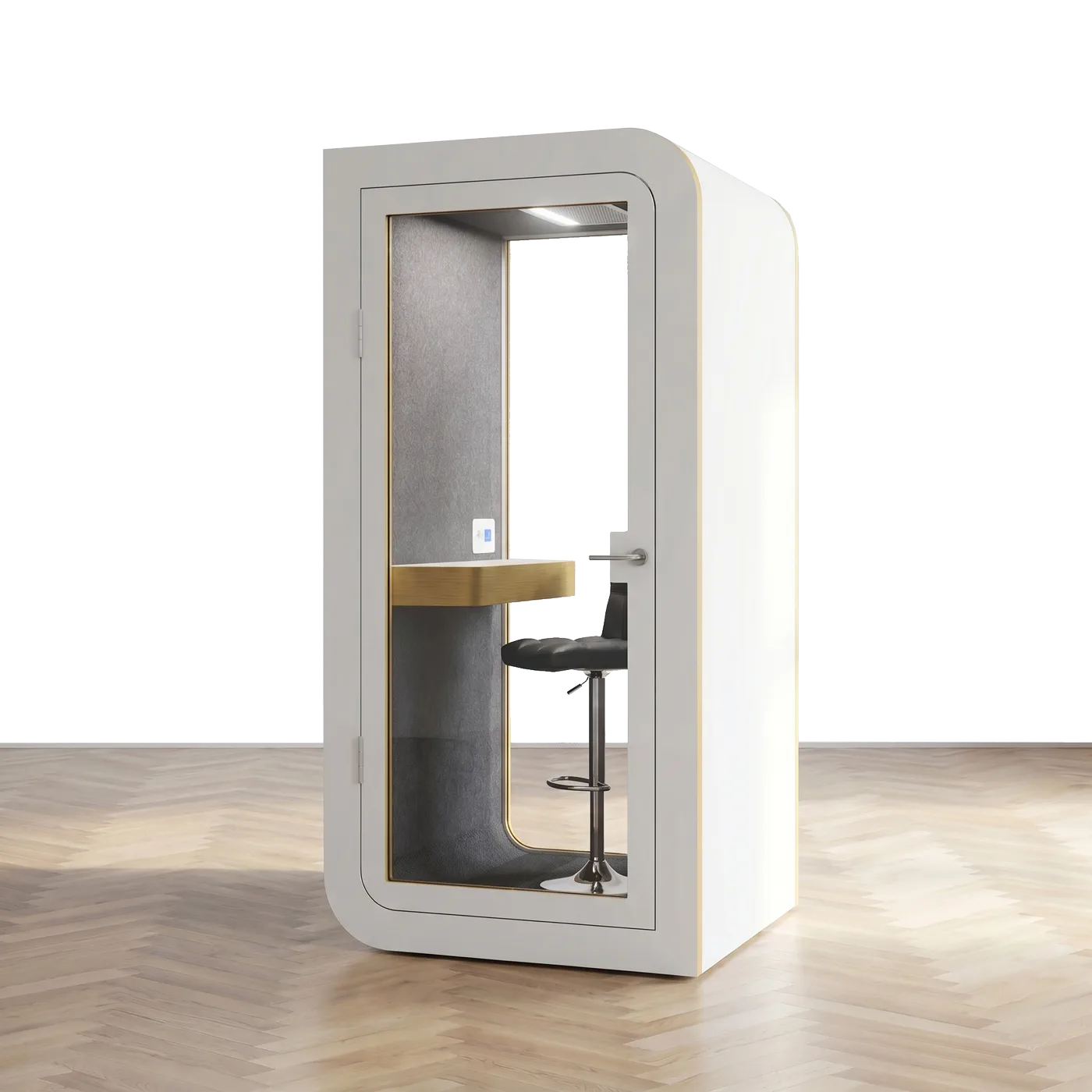
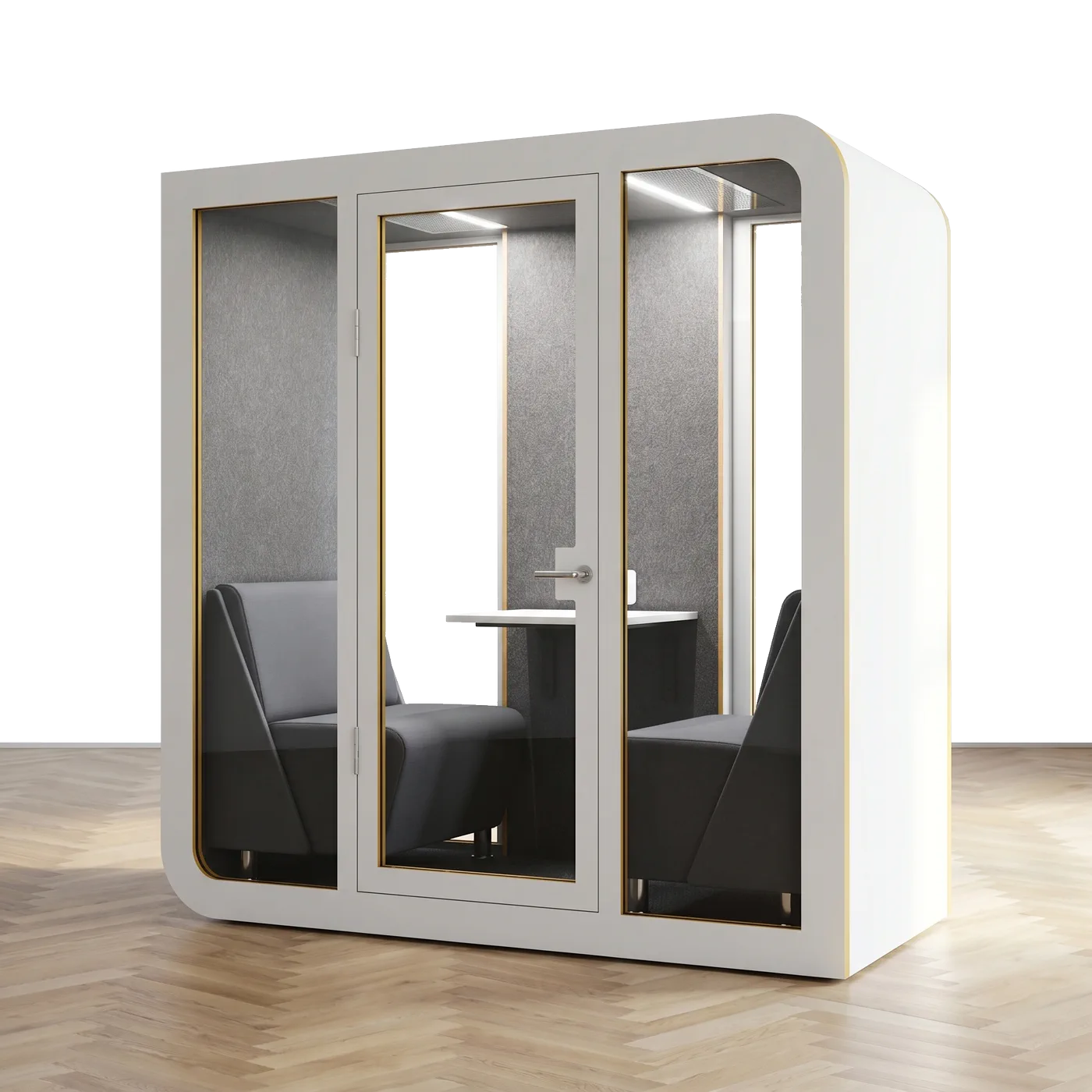
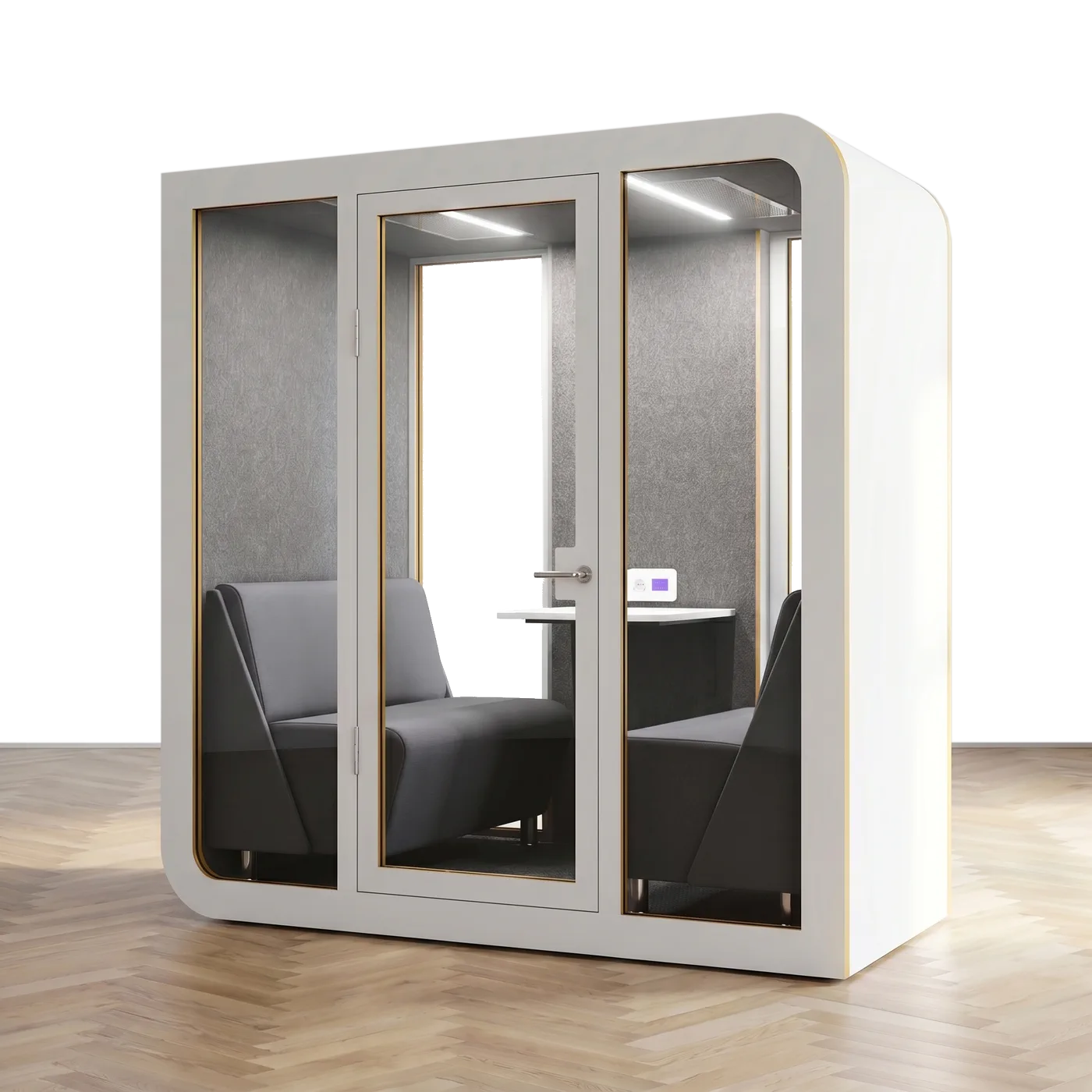
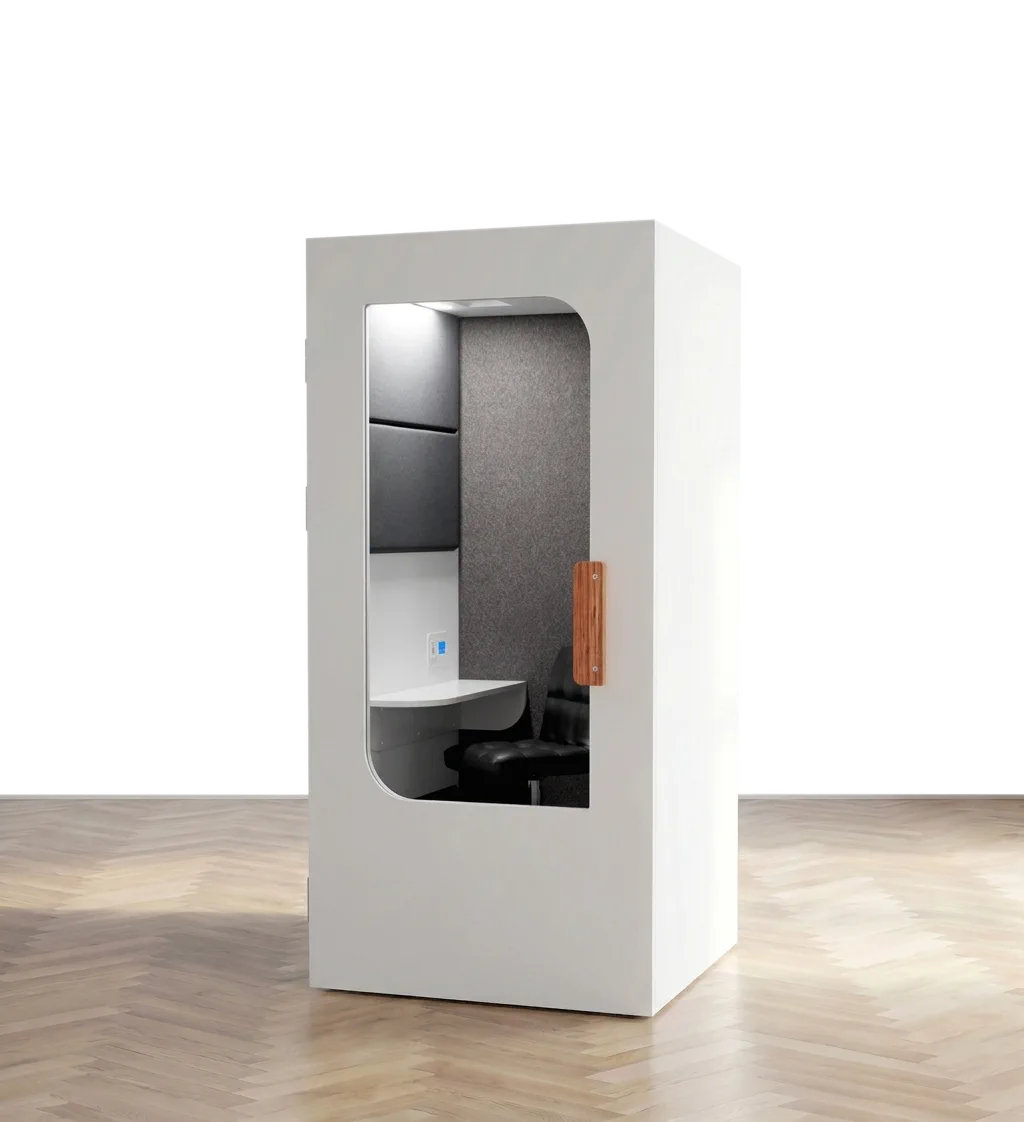
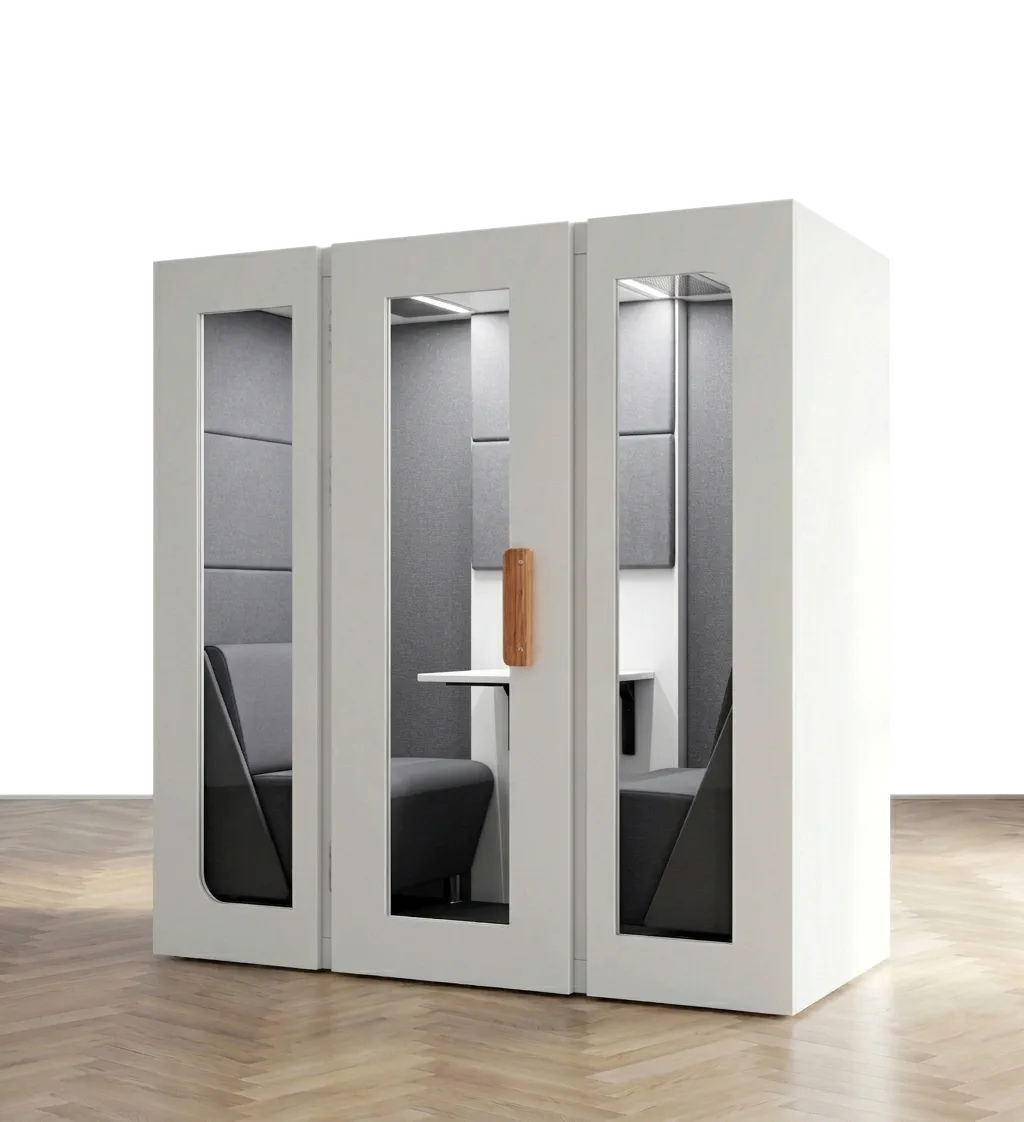
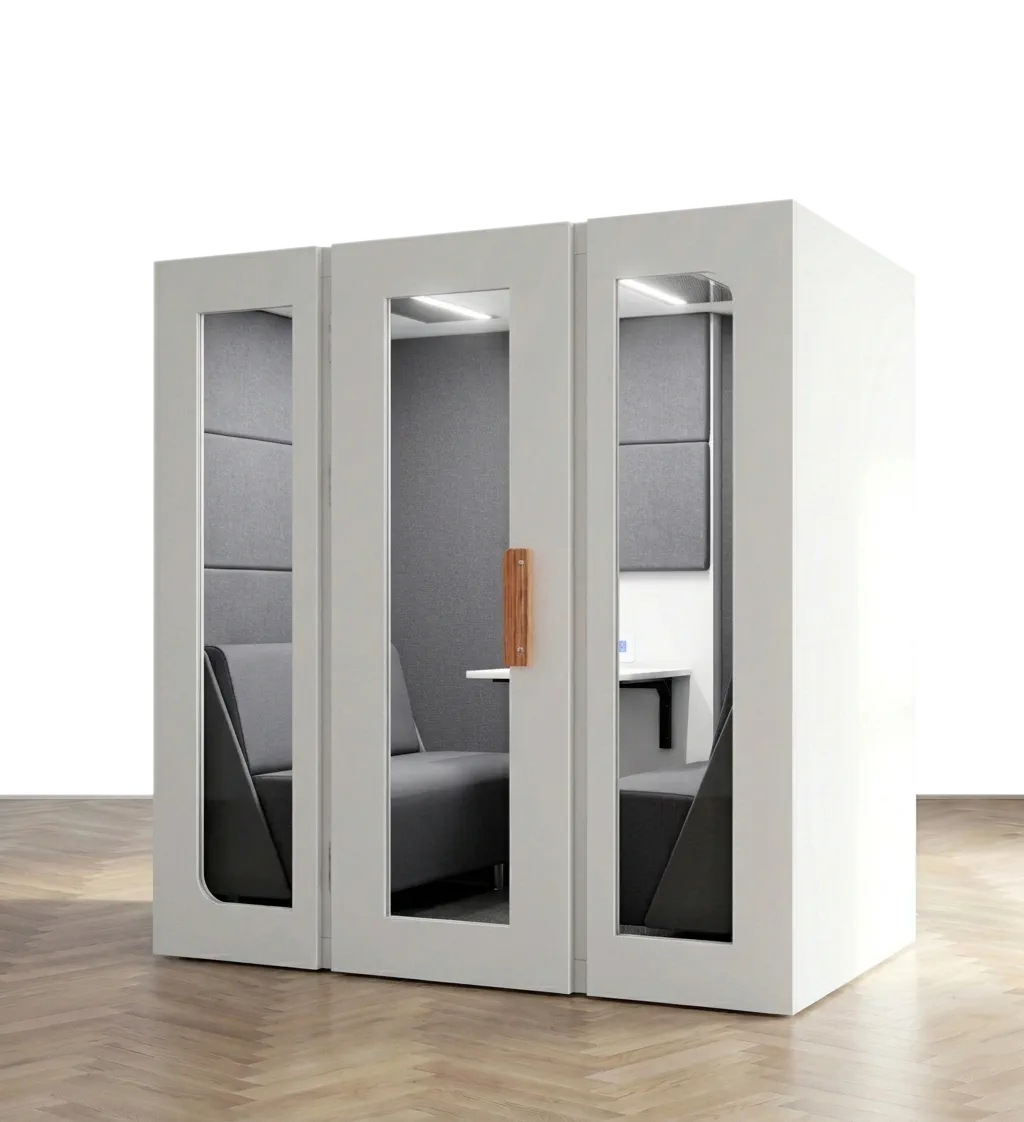
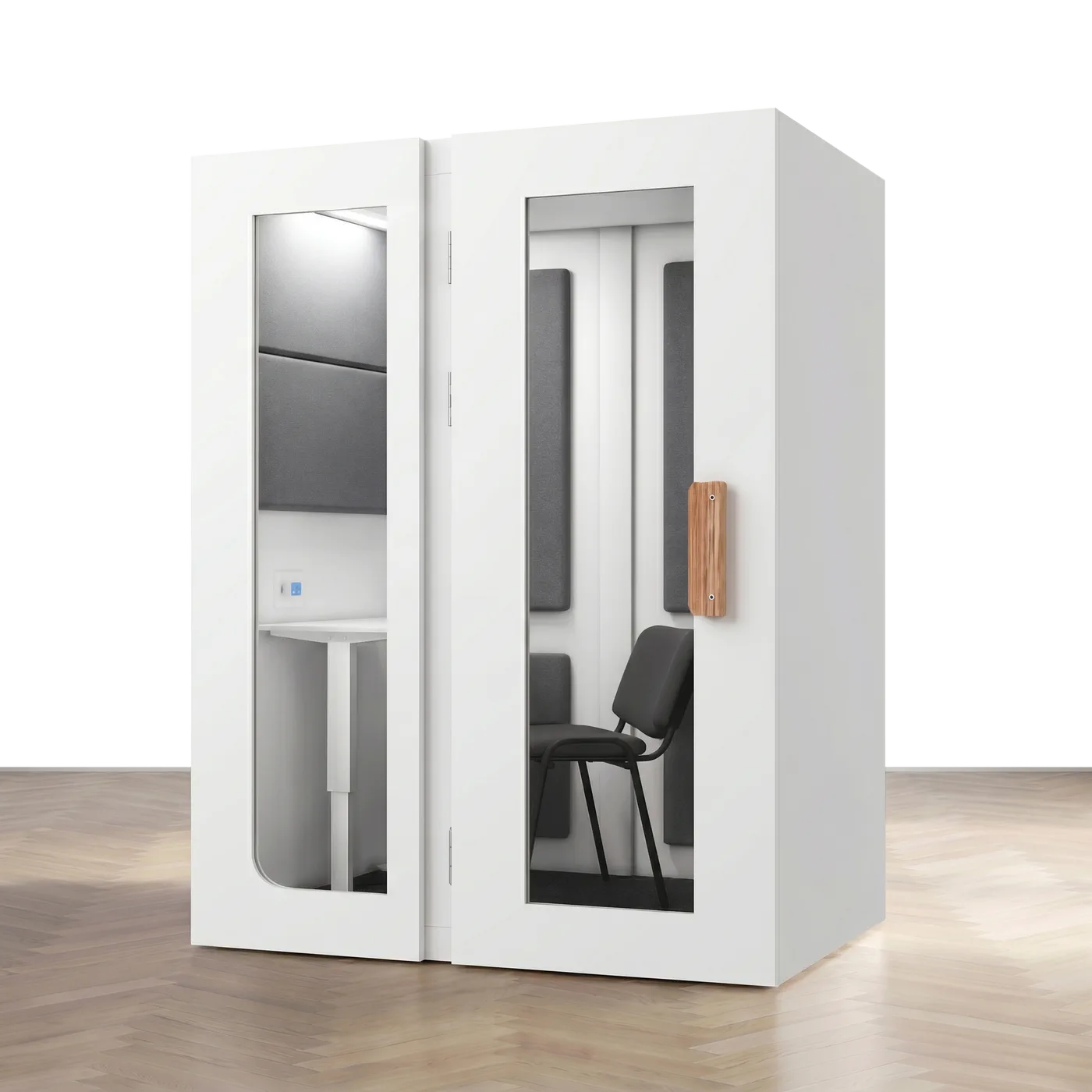
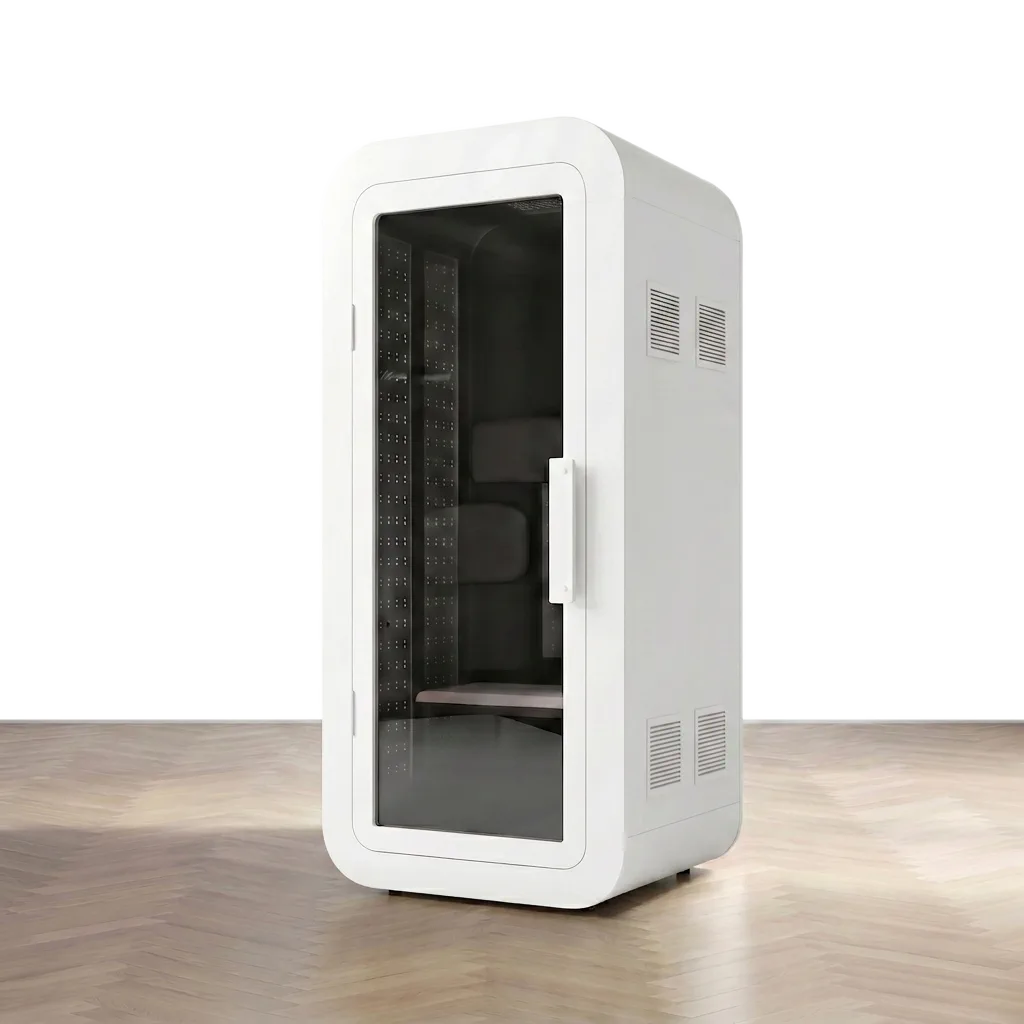
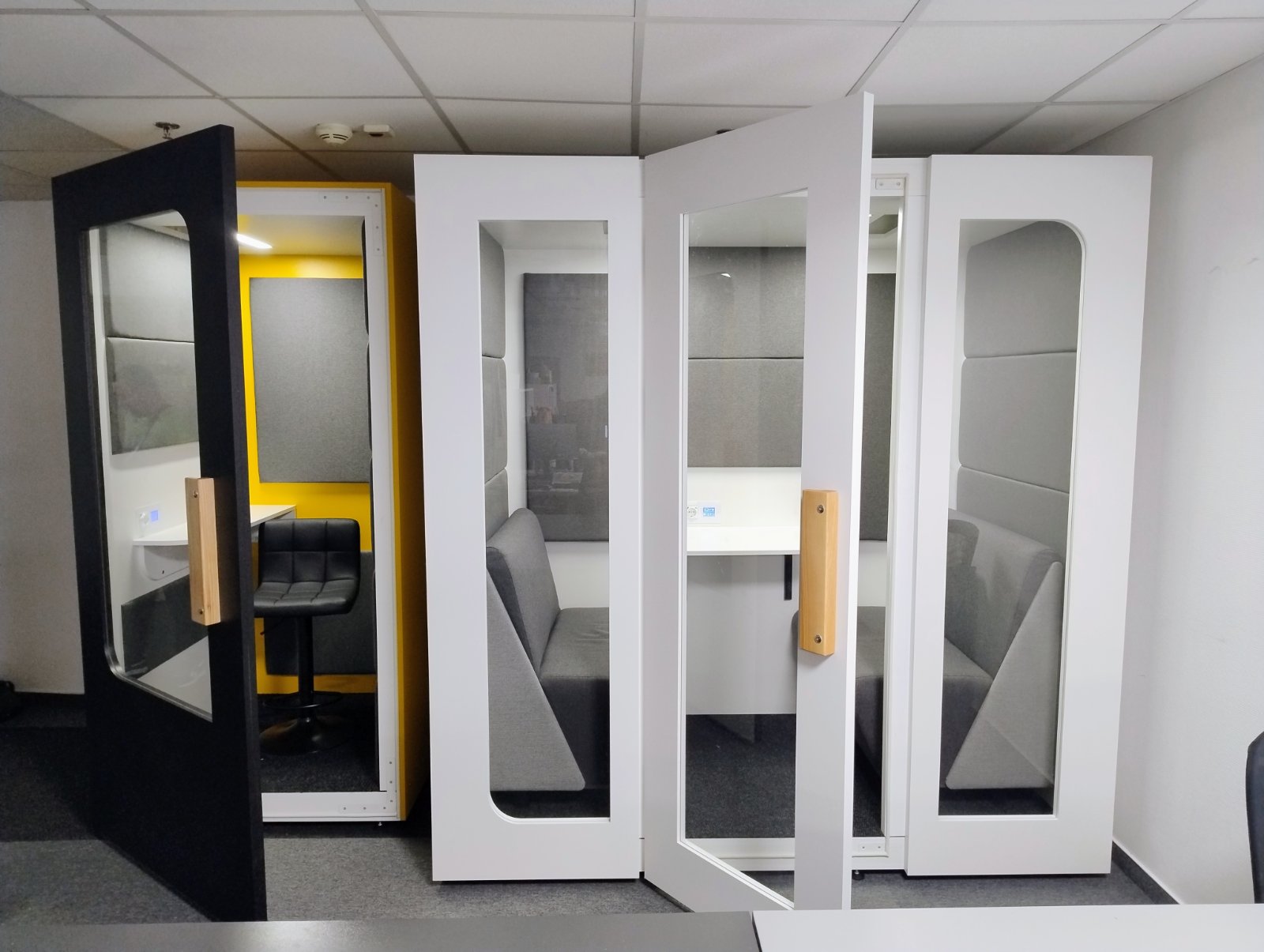
Office booths have become a standard fixture in companies that want to offer their teams quiet, private places to work. Whether the need is calls, meetings or focus work, a good acoustic booth changes how a floor operates. The models on the market differ far more than the photographs suggest, though — here are the seven criteria worth checking before committing.
1. Sound insulation
This is the criterion everything else depends on. A booth that does not meaningfully reduce noise is a glass cupboard with a chair in it.
- The insulation figure in decibels, and the standard behind it: ISO 11957 is the international method for measuring the sound insulation of cabins, while ISO 23351-1 describes a laboratory method for how much a booth reduces the level of speech from the person inside. The two figures are different quantities, so ask which one a figure describes
- What the reduction buys you: ~25 dB (the Lite series and WorkPod) dampens office noise for calls and focus work, while 35 dB (the Premium series — Solo, Duet and Quartet) is the level meant for confidential conversations
- The construction and materials: high-density panels and proper acoustic layering, not decorative felt over a thin shell
2. Size and adaptability
Size follows use. A one-person booth for calls and a meeting pod for four are different products solving different problems, and buying the wrong one is an expensive way to find that out.
- Capacity: Solo and WorkPod for one person, Duet for two, Quartet for up to four
- Whether the booth can be moved or reconfigured later if the office layout changes
- The footprint it needs, including door clearance and circulation around it
Silentbox models compared: capacity, sound insulation, airflow and installation time
| Model | People | Sound insulation | Airflow | Installation |
|---|---|---|---|---|
| Solo Premium | 1 | 35 dB | 300 m³/h | 2–3 hours |
| Duet Premium | 2 | 35 dB | 550–600 m³/h | 3–5 hours |
| Quartet Premium | up to 4 | 35 dB | 550–600 m³/h | from 2 hours |
| Solo Lite | 1 | ~25 dB | 250–300 m³/h | 2–3 hours |
| Duet Lite | 2 | ~25 dB | 550–600 m³/h | 3–4 hours |
| Quartet Lite | up to 4 | ~25 dB | 550–600 m³/h | from 2 hours |
| WorkPod | 1 | ~25 dB | 250–300 m³/h | 2–3 hours |
Figures from the Silentbox model cards. Every model has ventilation with an occupancy sensor; supply and exhaust both sit in the ceiling. Warranty: the Premium series carries 10 years on the structure and frame, 5 years on electronics and 3 years on moving parts; the Lite series and WorkPod carry 3 years.
3. Ergonomics and comfort
Comfort determines whether a booth gets used at all. A poorly ventilated one soon feels stuffy and quietly turns into storage.
- Ventilation: check it is fitted as standard and works quietly enough not to intrude on a call
- Airflow per model, stated in m³/h: in Silentbox booths it ranges from 250 to 600 m³/h depending on the model (see the table above). An occupancy sensor switches the ventilation on, supply and exhaust both sit in the ceiling, and acoustic silencers keep the fans quiet
- Lighting: soft, or with natural light through glazing, to avoid eye strain over long sessions
- Built-in furniture — a proper work surface and seating suited to the intended use
4. Privacy and security
If the booth is meant for client calls or private meetings, privacy has to be genuine rather than implied.
- Door sealing and closing mechanism — this is where cheaper booths leak most of their sound
- Glazing and layout: whether screens are visible from outside during video calls
- Sockets and connectivity inside, so devices are used within the booth rather than at the door
5. Design and fit with the office
A booth is a large, visible object. It will either read as part of the interior or as a box someone left in the corner — and that is decided at the point of purchase, not afterwards.
- Materials and finishes that sit comfortably with the existing furniture
- Customisation options: colours, panel materials, additional equipment
- How the booth looks from the side people see most often, not just from the front
6. Installation and maintenance
A booth that takes a week and a contractor to install costs considerably more than its price tag suggests. The best case is that it arrives, goes up in a few hours, and needs nothing but a level floor and a standard 220 V outlet.
- Assembly method: on-site assembly with no renovation or building work. Silentbox booths are free-standing, not fixed to the floor or walls, and can be dismantled and moved if the office relocates
- Installation time per model: 2–3 hours for Solo Premium, Solo Lite and WorkPod, 3–4 hours for Duet Lite, 3–5 hours for Duet Premium, and from 2 hours for Quartet Premium and Quartet Lite
- Lead time: production takes 3–6 weeks, then delivery within Europe takes 10–25 days depending on the country — for example 10 days to Poland, 15 to Germany and 25 to the UK — so 5–9 weeks in total from order confirmation
- Materials that are easy to clean and stand up to daily use
- Warranty by series: the Premium series (Solo, Duet, Quartet) carries 10 years on the structure and frame, 5 years on electronics and 3 years on moving parts; Solo Lite, Duet Lite, Quartet Lite and WorkPod carry 3 years
- Service from the manufacturer: Silentbox responds within 48 hours of a request
7. Value for money
Price alone says very little. What matters is the balance between acoustic performance, comfort, durability and total cost — including delivery, installation and upkeep across the years the booth will actually be in service.
When comparing quotes, check what each price covers. Silentbox catalogue prices exclude VAT, and delivery and installation are charged separately; logistics start from €300. The “from” price on a model card applies to orders of five or more booths in total: a Solo Premium is listed from €4,790, while a single unit costs €5,690 and three or four cost €5,190 each.
Buying for an office in Great Britain: what the rules leave to you
Great Britain's noise law is about hearing: the Control of Noise at Work Regulations 2005 set exposure values of 80, 85 and 87 dB(A), with no separate figure for offices. Comfort targets come from guidance such as BS 8233:2014, so the insulation level you choose under criterion 1 is your decision, not a legal threshold. Ventilation is a separate duty under the Workplace Regulations 1992:
Effective and suitable provision shall be made to ensure that every enclosed workplace is ventilated by a sufficient quantity of fresh or purified air.
The Workplace (Health, Safety and Welfare) Regulations 1992, reg. 6(1)
In England, Approved Document F sets outdoor-air rates for offices (see our ventilation guide). These duties rest with the employer and the building designer, not with the booth. A booth draws its air from the office, so place it in a well-ventilated area and not under ceiling air-conditioning diffusers, which interfere with the booth's own ventilation.
In closing
Choosing the right office booth comes down to matching the specification to the job: decibels for confidentiality, size for the way it will be used, ventilation and lighting for comfort, and warranty terms checked component by component. Get those right and a booth turns a loud floor into a workable one. The Silentbox range covers Solo, Duet and Quartet in the Premium and Lite series, plus the WorkPod for one person — worth comparing against the criteria above before you decide.
Questions about choosing a booth
How much floor space does an office booth need?
A Solo Premium measures 1050 × 1100 × 2250 mm, a Duet Lite 2130 × 1050 × 2250 mm (2.2 m²) and a Quartet Premium 2100 × 1380 × 2250 mm (2.9 m²). Allow extra space for the door to open and for people to walk around the booth.
How long does it take from order to a working booth?
Production takes 3–6 weeks, then delivery takes 10–25 days depending on the country (25 days to the UK): 5–9 weeks in total from order confirmation. Installation then takes from 2 hours.
Does a booth need building work or a connection to the building's ventilation?
No. The booths are free-standing, not fixed to the floor, walls or ceiling, and need only a standard 220 V socket. Each has its own forced ventilation rated at 250–600 m³/h, with supply and exhaust in the ceiling unit.
What does the catalogue price include?
The booth itself, excl. VAT; delivery and installation are quoted separately, and logistics start from €300. The “from” price applies to orders of five or more booths in total; a single Solo Premium costs €5,690, excl. VAT.
Which booth suits two people?
Duet Premium (35 dB) costs €10,190 for a single booth and Duet Lite (~25 dB) €7,190 for a single booth, both excl. VAT. Around 25 dB is comfortable for video conferences, but it is not full acoustic isolation for confidential negotiations — that level belongs to the Premium series.
Sources
- ISO 11957:1996 Sound insulation performance of cabins (catalogue page)
- ISO 23351-1:2020 Speech level reduction of furniture ensembles and enclosures (catalogue page)
- The Control of Noise at Work Regulations 2005, regulation 4
- The Workplace (Health, Safety and Welfare) Regulations 1992, regulation 6
- Approved Document F, Volume 2 (2021 edition, England), PDF